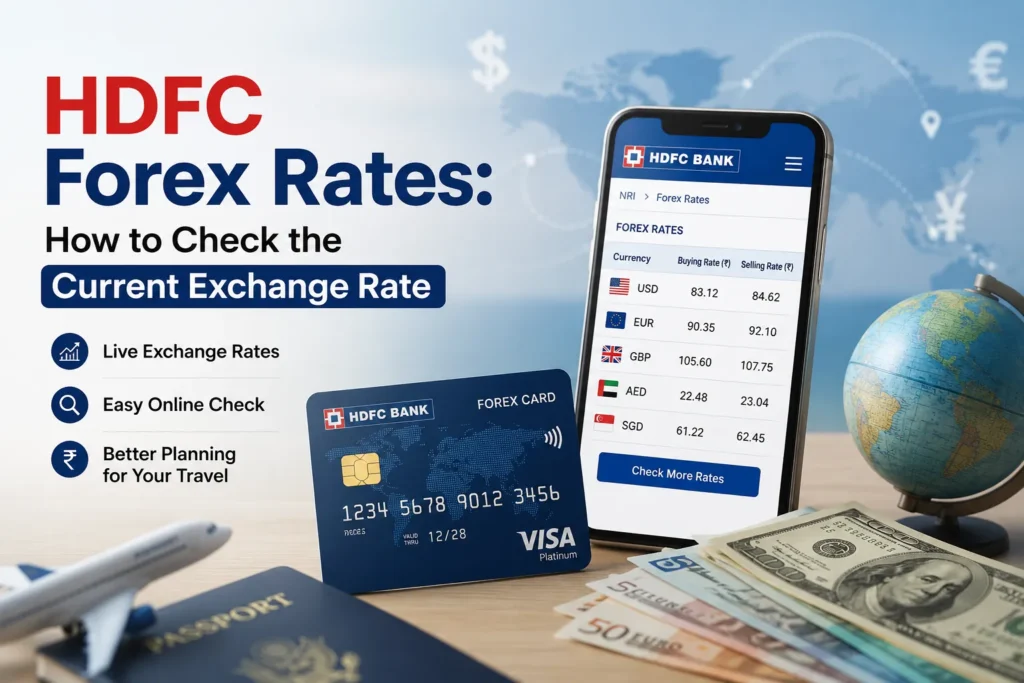
The HDFC forex rate is not a fixed figure — it is revised through the trading day in line with movement in the currency market. A rate checked in the morning may no longer hold by evening. This guide, therefore, does not quote a number that would be outdated within hours. Instead, it sets out where the rate can be verified, how the terminology is to be read, and where a bank’s margin is typically built in. This is relevant whether one is loading a forex card ahead of travel to Europe, exchanging cash before a US visa interview, or comparing options before remitting funds abroad.
Page Contents
Where to Check HDFC’s Forex Rate Today
HDFC Bank’s Official Website
The Forex or Currency Exchange Rates section on HDFC’s official website remains the most reliable source. Buying and selling rates are listed for major currencies — USD, GBP, EUR, AED, SGD, and several others — and these are updated through the course of business hours. Customers wishing to track HDFC’s forex rate on a given day should refer to this page in the first instance.
HDFC Bank Mobile Application
Customers holding an HDFC forex card will typically find rates specific to their card under the Forex or Cards section of the mobile application. This is often more convenient than the website when checking rates while travelling, particularly where connectivity is limited.
Branch Visit or Customer Care
For currencies not listed online, or where confirmation is sought prior to a large transaction, customers may contact HDFC’s customer care or visit a branch. Branch staff are also able to clarify fees that may not be evident on the website.
Rate Comparison Websites
Third-party comparison websites can be useful for gauging how HDFC’s rate compares with other banks, such as SBI or ICICI, or with dedicated forex service providers. However, such figures may lag the live rate by several hours and should not be relied upon for an actual transaction. It is advisable to verify the applicable rate on HDFC’s own platform before proceeding.
Buying Rate, Selling Rate and Mid-Market Rate: The Distinction
Three terms recur across any bank’s forex page, and HDFC’s is no exception:
- Buying rate — the rate at which HDFC purchases foreign currency from the customer, such as unused balance following a trip.
- Selling rate — the rate at which the customer purchases currency from HDFC, or loads a forex card.
- Mid-market rate — approximately the midpoint between the two, and the figure typically displayed on platforms such as Google or XE. This serves as a benchmark rather than a rate at which a transaction can actually be conducted.
The difference between HDFC’s selling rate and the mid-market benchmark constitutes the bank’s margin on the transaction, separate from any fees charged in addition. This practice is common across Indian banks and is not particular to HDFC; it is a factor worth accounting for regardless of which bank a customer chooses.
Factors That Influence the Quoted Rate
- Movement in global currency markets — rates shift through the trading day on account of international market activity, and can vary noticeably between morning and evening.
- The bank’s own markup — applied over the market rate, and the principal factor differentiating HDFC’s pricing from that of other banks.
- Card type — a premium card such as Regalia may carry a different markup structure compared to a basic multi-currency forex card.
- Size and mode of transaction — a large wire transfer is not priced on the same basis as a smaller card reload.
Fees Not Reflected in the Headline Rate
| Fee | Applicability |
|---|---|
| Card issuance | Levied once, at the time the card is issued |
| Reload/loading fee | Applicable each time the card is topped up |
| ATM withdrawal abroad | Applicable per cash withdrawal at a foreign ATM |
| Cross-currency conversion | Applicable when spending in a currency the card does not hold |
| Dormancy fee | Applicable where the card remains unused for an extended period |
These charges are subject to periodic revision. The table above should therefore be treated as an indicative checklist rather than a fixed price list, and the current fee schedule should be confirmed on HDFC’s website prior to travel.
Securing a More Favourable Rate
- Compare with at least one other provider before loading funds: the difference between HDFC’s rate and that of, say, SBI or a dedicated forex specialist can be material on a sizeable transaction.
- Avoid transacting at the airport: airport counters generally offer the least favourable rates. It is preferable to load the card or purchase currency a few days in advance.
- Consolidate transactions: loading funds in fewer, larger instalments reduces the frequency with which the reload fee is charged.
- Match the currency loaded to the destination of spend: loading US dollars and subsequently spending in, for instance, Thailand or Vietnam, attracts a cross-currency conversion fee that could otherwise be avoided.
Loading and Reloading the HDFC Forex Card
Top-ups may be carried out via NetBanking, the mobile application, or at a branch. Online channels are generally faster for routine reloads. Where an uncommon currency or a larger sum is involved, a branch visit may be preferable, as service in such cases is often better handled in person. In either case, customers should ascertain whether a loading premium applies before confirming the transaction, as this is not always disclosed clearly at the payment stage.
Using the Card Abroad: Points Worth Noting
- Where possible, transactions should be routed through HDFC’s partner ATM network abroad, as this helps contain withdrawal charges.
- Where a merchant terminal offers the choice between INR and local currency, local currency should invariably be selected. Opting for INR triggers Dynamic Currency Conversion, which typically results in a less favourable effective rate.
- Daily withdrawal and spending limits should be verified before departure, so as to avoid a transaction being declined while abroad.
In the Event the Card Is Lost or Stolen
The card should be blocked without delay, either through NetBanking, the mobile application, or HDFC’s 24/7 customer care line. Prompt reporting limits potential misuse of the remaining balance.
Frequently Asked Questions
How often does HDFC revise its forex rate?
The rate is revised multiple times during the day in line with market movement. It is advisable to check the rate afresh before any transaction, as the figure noted on a previous occasion may no longer apply.
Is the forex card rate the same as HDFC’s general forex rate?
Not necessarily. The general forex rate applies to cash exchange or wire transfers, whereas the card rate applies specifically to loading and spending on a prepaid forex card. The two may differ marginally on account of differing fee structures.
Can the rate be checked without logging into NetBanking?
Yes. HDFC’s public website displays indicative rates that can be viewed without logging in. Rates specific to a customer’s card or account, however, require login.
Are there hidden charges on the HDFC forex card?
The charges are not concealed as such, but are easily overlooked where attention is confined to the exchange rate alone. Customers are advised to refer to the current fee schedule on HDFC’s website rather than relying solely on the headline rate.
Can the HDFC forex card be reloaded from outside India?
Yes. Reloading may be carried out via NetBanking or the mobile application regardless of whether the customer is within India or abroad at the time.
Disclaimer: This guide is not affiliated with or endorsed by HDFC Bank. Rates and fees are subject to change; customers are advised to confirm current details on HDFC’s official website or app before transacting.