Quick Answer: A GST late payment interest calculator works out your Section 50 liability using one formula: Net Tax Amount × 18% × Days Late ÷ 365. The rate is a uniform 18% per annum for standard late payment of tax AND for excess input tax credit claimed and utilized. This guide breaks down the rate rules, the formula, QRMP variations, and includes a free Excel version you can download and reuse every month.
Page Contents
What Is Interest Under GST (Section 50)?
Key Takeaway: Interest under GST Section 50 is a mandatory, uncapped daily charge on a registered taxpayer’s net tax liability paid after the due date, or on excess input tax credit that’s been wrongly claimed and used.
Interest is completely separate from the late fee you pay for filing a return late. You can owe both interest and a late fee for the same delayed return. Unlike the late fee, GST interest has no maximum cap. It keeps accruing at the applicable rate for every single day of delay, however long that turns out to be.
This is why it helps to run the numbers through a GST late payment interest calculator early, rather than waiting until you file, since the figure only grows with time. You can read the full text of Section 50 on the official GST portal for the exact statutory wording.
The Uniform 18% GST Interest Rate
If you have read older articles or used an older GST late payment interest calculator, you might be confused about whether the rate is 18% or 24%. Today, the GST interest rate is a uniform 18% per annum for all scenarios.
- Late Payment of Tax (Section 50(1)): When you pay your output tax liability after the due date, an 18% rate applies.
- Excess ITC Claimed and Utilized (Section 50(3)): If you look at the bare text of Section 50(3), it states a rate “not exceeding 24%.” Many tax blogs mistakenly cite this statutory ceiling as the active rate. However, through Section 116 of the Finance Act 2022, the government directly amended the original rate notification (Notification No. 13/2017-Central Tax), permanently dropping the active rate to 18%.Crucially, this was applied retrospectively back to July 1, 2017. Any GST late payment interest calculator outputting 24% today is overcharging you.
GST Interest Calculation Formula
The formula powering our GST late payment interest calculator is straightforward:
Interest = Net Tax Amount × 18 ÷ 100 × Days Late ÷ 365
Days are counted from the day immediately after the due date, up to and including the date the tax is actually paid.
Worked Example
Say a taxpayer owes Rs. 1,00,000 in net tax for GSTR-3B, due on 20 June, but pays on 20 July. That is 30 days late.
- Tax amount: Rs. 1,00,000
- Rate: 18% per annum
- Days late: 30
- Interest calculation: 1,00,000 × 18/100 × 30/365 = Rs. 1,479
Since GST is split into CGST and SGST for an intra-state supply, this Rs. 1,479 is divided equally: Rs. 739.73 goes toward CGST interest and Rs. 739.73 toward SGST. For an inter-state supply, the full amount sits under IGST instead.
Is GST Interest Charged on Gross or Net Tax Liability?
Key Takeaway: GST interest is charged only on the net tax liability. This means a GST late payment interest calculator should only be applied to the amount paid in cash via the electronic cash ledger, after adjusting all eligible input tax credit (ITC).
This was not always crystal clear. For a period after GST rolled out, there was genuine confusion based on charging interest on the gross liability. A proviso inserted through the Finance Act 2019 settled this, applying it retrospectively from 1 July 2017. If you are using an old GST late payment interest calculator template downloaded years ago, ensure it reflects this net-liability basis. You can cross-check current provisions directly on the CBIC portal.
Free Excel Template: GST Late Payment Interest Calculator
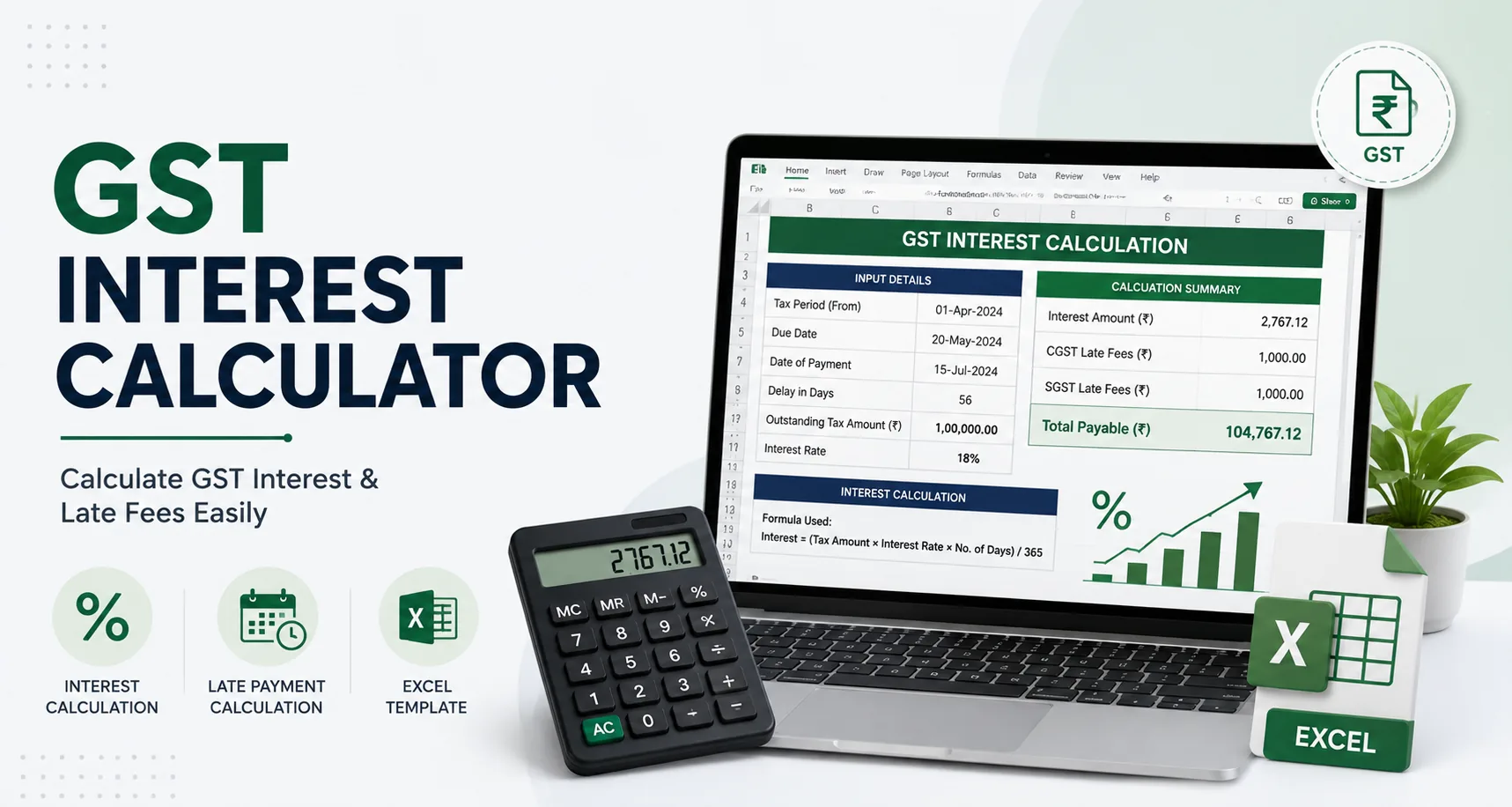
If you calculate this every month, typing the formula manually gets old fast. Below is a downloadable GST late payment interest calculator in Excel with the Section 50 formula wired in, plus a second sheet for the late fee. Both recalculate automatically as soon as you change the dates or amounts.
Download GST Interest & Late Fee Calculator (Excel)
What is inside:
- Interest Calculator sheet: Enter the tax amount, due date, and payment date. The days late, interest, and CGST/SGST split calculate automatically.
- Late Fee Calculator sheet: A matching sheet for Section 47, using the
MIN(days × rate, cap)logic. - Rate Reference sheet: The current interest rates and GSTR-3B due dates, all in one place.
Note: The file has no macros and no external links, so it opens safely in Excel, LibreOffice, or Google Sheets.
GST Interest Under the QRMP Scheme
Key Takeaway: For taxpayers under the Quarterly Return Monthly Payment (QRMP) scheme, a standard GST late payment interest calculator must be adjusted for the first two months of the quarter, depending on whether you use the Fixed Sum Method (FSM) or the Self-Assessment Method (SAM).
- Fixed Sum Method (FSM): You deposit a pre-filled amount by the 25th of the first two months. If deposited on time, no interest applies for those months, even though the return isn’t filed yet. Interest only kicks in if you miss this monthly deposit deadline.
- Self-Assessment Method (SAM): You calculate your actual tax liability for each month. If the full amount is not paid by the 25th, interest at 18% per annum applies from the day after that deadline until you actually pay.
When you finally file the quarterly GSTR-3B, any tax that was still outstanding for the earlier months attracts interest calculated from that month’s original due date. Check our GSTR-3B due dates guide for exact state-wise deadlines.
GST Late Fee vs. GST Interest: What is the Difference?
These two charges get confused constantly, but they are calculated completely differently.
- Late fee is a fixed per-day charge for filing the return itself after the due date. It applies even if you owe zero tax and has a maximum cap.
- Interest, the focus of our GST late payment interest calculator, is a percentage (18%) of your unpaid cash tax, charged only when there is an actual liability paid late. It does not have a cap.
If you both file late and pay late, you owe both. For the full breakdown by return type, see our GST late fee calculator guide.
How to Pay GST Interest
Interest is self-assessed, meaning the portal does not calculate and add it automatically. You must run a GST late payment interest calculator yourself and include the amount through one of two routes:
- Through your next GSTR-3B: Report the amount in Table 5.1 of the return and pay it in cash through the electronic cash ledger at the time of filing.
- Form DRC-03: Used for a voluntary payment made outside the return, typically after you’ve spotted an error or received a notice.
Crucial note: Interest can only be paid in cash. It cannot be adjusted against input tax credit. If you need to reconcile your ITC before filing, see our GSTR-2B reconciliation guide.
Quick Reference: Interest at 18% for Common Amounts
| Net Tax Amount | 15 Days Late | 30 Days Late | 60 Days Late | 90 Days Late |
| Rs. 10,000 | Rs. 74 | Rs. 148 | Rs. 296 | Rs. 444 |
| Rs. 50,000 | Rs. 370 | Rs. 740 | Rs. 1,479 | Rs. 2,219 |
| Rs. 1,00,000 | Rs. 740 | Rs. 1,479 | Rs. 2,959 | Rs. 4,438 |
| Rs. 5,00,000 | Rs. 3,699 | Rs. 7,397 | Rs. 14,795 | Rs. 22,192 |
These are indicative figures. Use the formula or our free GST late payment interest calculator for precise calculations.
Frequently Asked Questions
What is the formula for a GST late payment interest calculator?
The formula is: Net Tax Amount × 18% × Days Late ÷ 365. Days are counted from the day after the due date to the date of actual payment.
Is GST interest calculated on gross tax or net tax after ITC?
It is calculated strictly on net tax—meaning the amount actually paid in cash after adjusting your available input tax credit.
Is the GST interest rate 18% or 24%?
The rate is a uniform 18% for both late payment of output tax and the wrongful utilization of excess ITC. Any GST late payment interest calculator using 24% is outdated; Section 116 of the Finance Act 2022 amended the original rate notification to drop the rate to 18%, effective retrospectively from July 1, 2017.
Is there a cap on GST interest like there is on the late fee?
No. GST interest has no maximum cap and keeps accruing for as long as the tax remains unpaid.
Can I pay GST interest using my ITC balance?
No, GST interest can only be paid via the electronic cash ledger.
Disclaimer: This article is for informational purposes only and does not constitute financial or tax advice. Consult a qualified professional for decisions specific to your situation.
Read More – How to Calculate GST Percentage in Excel 2026 (Formulas & Free Sheet Format)
Sources
- Central Goods and Services Tax Act, 2017, Section 50 (Interest on Delayed Payment of Tax), CBIC
- CBIC GST Notifications