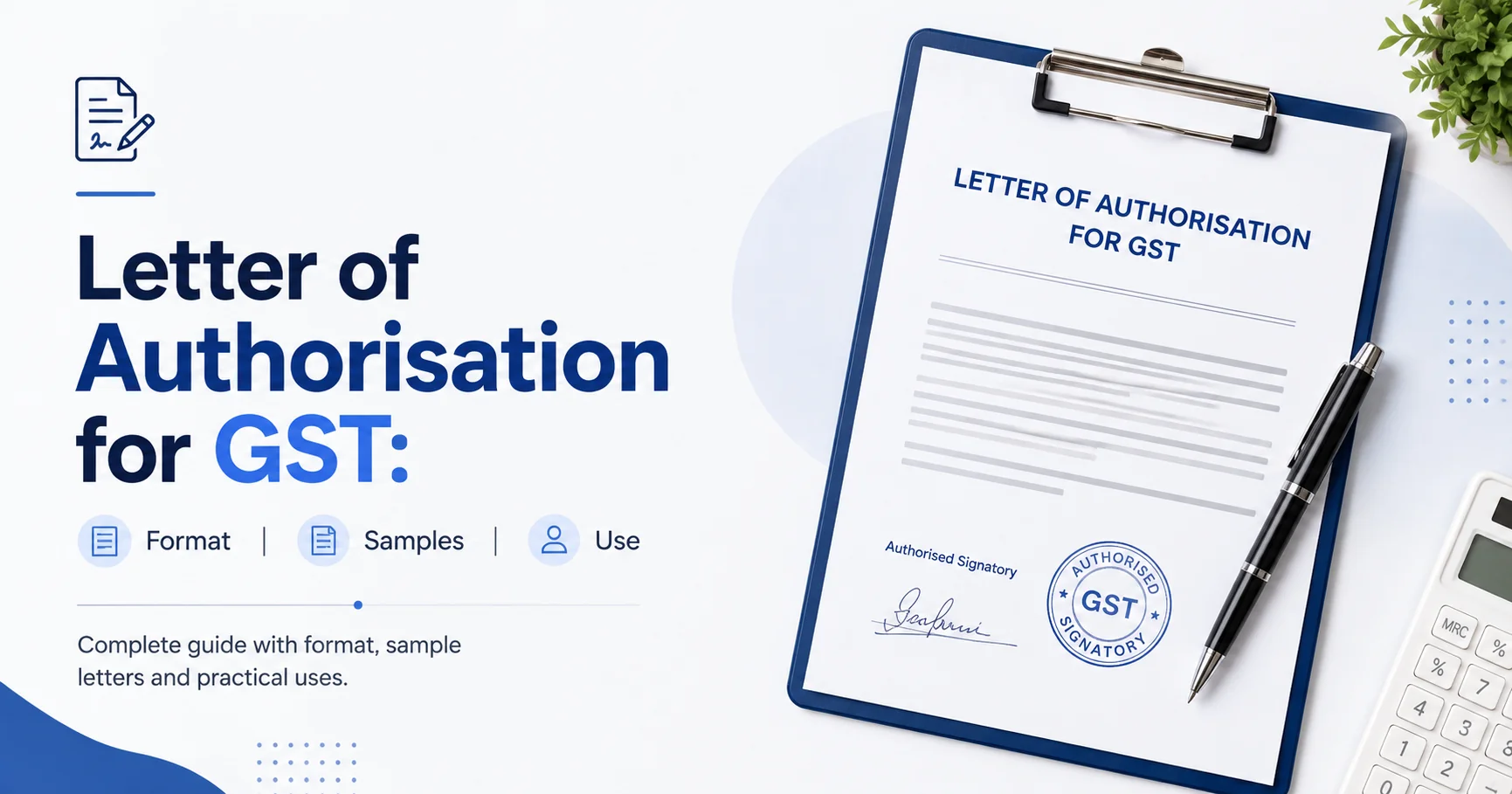
A letter of authorisation for GST is a signed document that allows a business to appoint someone, an employee, partner, or consultant, to act on its behalf for GST registration, filing, or communication with tax authorities. There are actually two distinct versions of this letter used at different stages, and most guides blur them together.
Page Contents
The two different GST authorisation letters
This is worth clearing up first, since it’s where a lot of confusion starts.
- The REG-01 declaration format. This is the specific, government-style declaration used when you first appoint an authorised signatory during GST registration. It follows a fixed structure (“I/We… hereby solemnly affirm and declare…”) and is uploaded as an attachment with Form GST REG-01.
- A general business authorisation letter. This is a more flexible, letterhead-style document used later, for ongoing representation, replying to notices, attending hearings, or handling routine compliance. It doesn’t follow one fixed wording, though it needs to cover certain essential details.
Both serve the same underlying purpose, giving someone formal permission to act for the business on GST matters, but they’re used in different situations and read quite differently. Below are both formats, each set apart so you can copy exactly what you need.
Format 1: Declaration for authorised signatory (for GST registration)
This is the format typically uploaded alongside Form GST REG-01 when appointing your authorised signatory at the time of registration.
📄 Download: Declaration for Authorised Signatory (Word doc) — ready to fill in and print on letterhead.
Declaration for Authorised Signatory
For GST registration · Form GST REG-01
I/We, [Name of Proprietor / all Partners / Karta / Directors], hereby solemnly affirm and declare that [Name of Authorised Signatory] is authorised to act as an authorised signatory for the business [Name of Business], for which application for registration is being filed under the Goods and Services Tax Act.
All his/her actions in relation to this business will be binding on me/us.
Acceptance as Authorised Signatory
I, [Name of Authorised Signatory], hereby solemnly accord my acceptance to act as authorised signatory for the above referred business, and all my acts shall be binding on the business.
A few things worth noting about this format specifically:
- It needs to be signed by everyone whose consent matters for the entity type, all partners in a partnership, the Karta in an HUF, or the relevant directors in a company.
- For private limited companies, this declaration alone usually isn’t enough. It needs to be backed by a Board Resolution authorising the appointment, since under company law the power to appoint a signatory flows from the board, not an individual director.
- It’s uploaded as a PDF or JPG file, generally capped around 1MB, along with the registration application on the GST portal.
- For a sole proprietorship, this letter usually isn’t required at all. The proprietor can select themselves as the authorised signatory directly on Form GST REG-01, with no separate document needed. A proprietor can still choose to authorise someone else (an employee, say) for day-to-day GST work, in which case this declaration is used.
Format 2: General letter of authorisation for GST matters
This version is used after registration, when you need to formally authorise someone to represent the business more broadly, replying to a notice, attending a hearing, filing returns, or handling ongoing correspondence with the GST department.
📄 Download: General Letter of Authorisation for GST (Word doc) — ready to fill in and print on letterhead.
General Letter of Authorisation
For ongoing GST representation
[Company Letterhead]
Date: [DD/MM/YYYY]
To,
The GST Department
[Jurisdiction / Office Address]
Subject: Authorisation to Represent [Company Name] in GST Matters
Dear Sir/Madam,
I/We, [Your Name], [Your Designation] of [Company Name], holding GSTIN [GSTIN Number], hereby authorise [Authorised Person’s Name], [Designation], to act as our authorised representative for matters relating to Goods and Services Tax.
The scope of this authorisation includes:
- Filing of GST returns and related forms
- Responding to notices, queries, or communications issued by GST authorities
- Appearing before GST officers and representing the company during proceedings
- Submitting documents, applications, and clarifications as required
Authorised representative
Name: [Authorised Person’s Name]
Designation: [Designation]
Contact Details: [Phone and Email]
This authorisation is valid from [Start Date] until [End Date], or until revoked earlier through written intimation.
Yours faithfully, for [Company Name]
This version gives you more flexibility than the registration-stage declaration. You can narrow the scope to specific tasks rather than granting blanket authority, and you can set a time limit rather than leaving it open-ended.
Who needs to issue this letter
Whether you need one, and who signs it, depends on the type of entity.
- Sole proprietorship – generally not required. The proprietor is the default authorised signatory. A letter is only needed if the proprietor wants to delegate GST work to someone else.
- Partnership firm – required. Typically all partners sign, or the letter should clearly state the partners’ consent.
- LLP – required. Signed by the designated partner(s), referencing the LLP’s registration details.
- Private limited company – required, and needs a Board Resolution attached alongside it, since a single director’s signature on the letter isn’t treated as sufficient authority on its own.
- HUF – required, signed by the Karta.
- Trust or Society – required, typically signed by the authorised trustee or office bearer as per the trust deed or society’s governing rules.
What the letter must include
Regardless of which format you’re using, a valid letter of authorisation for GST should cover:
- Legal name of the business and its GSTIN, if already registered.
- Full name and designation of the person being authorised.
- An identity reference for that person, typically PAN or Aadhaar.
- A clear scope of authority. Vague language like “all GST matters” grants broad power and carries more risk than necessary. Listing specific tasks (filing returns, replying to a particular notice, attending a specific hearing) is generally the safer approach.
- The duration, either a defined start and end date, or “until further notice” if it’s meant to be ongoing.
- Signatures of both the authorising person(s) and the authorised representative, along with the company seal where applicable.
Why GST authorisation letters get rejected
This document gets flagged more often than people expect during registration and amendments. The common causes are worth knowing before you submit.
- Name mismatch with PAN records. Even a small spelling difference between the name on the letter and the name on file can trigger a rejection or clarification notice. Copy the legal name directly from the PAN or GST application rather than retyping it.
- Missing signature. An unsigned letter carries no legal weight, since it shows no actual consent was given.
- Wrong format for the entity type. A proprietorship-style letter used for a partnership, or a company skipping its Board Resolution, tends to raise doubts about who genuinely holds the authority to appoint a signatory.
- No Board Resolution for companies. For a private limited company, the authorisation letter by itself generally isn’t treated as sufficient. It’s the Board Resolution that establishes the authority.
- Wrong file format. Blurry mobile photos or image files instead of a clean, scanned PDF slow down verification and can invite rejection on formatting grounds alone.
If your GST registration application is rejected because of an authorisation issue, the rejection typically comes through Form GST REG-05, stating the specific reason. Fixing the identified issue and reapplying is usually more straightforward than trying to appeal a formatting-related rejection.
How to submit the letter on the GST portal
The exact step depends on when you’re submitting it.
- During registration: upload the signed letter (PDF or JPG, generally under 1MB) in the Authorised Signatory section of Form GST REG-01, alongside the Board Resolution if applicable.
- When changing an authorised signatory later: log in to the GST portal, go to Services > Registration > Amendment of Non-Core Fields or Core Fields (depending on what’s changing), and upload the new letter before submitting with DSC or EVC.
- If requested during scrutiny or a notice: the letter can usually be uploaded as a supporting document through the Reply option on the relevant entry under Services > User Services > View Notices and Orders.
Frequently asked questions
Is a letter of authorisation mandatory for GST registration?
For most entities, yes, except sole proprietorships, where the proprietor is the default signatory. Partnerships, LLPs, companies, HUFs, trusts, and societies generally need one when appointing someone as the authorised signatory.
Can an employee be authorised for GST work?
Yes. Businesses commonly authorise accountants, finance staff, or consultants like Chartered Accountants for routine GST compliance.
Does the letter need to be notarised?
No. Notarisation isn’t a requirement. A signed letter on the appropriate letterhead, with the correct supporting documents (like a Board Resolution for companies), is generally sufficient.
Can the scope of authorisation be limited to specific tasks?
Yes, and it’s generally advisable to do so. Rather than granting broad authority over “all GST matters,” listing specific tasks (filing returns, replying to a particular notice) limits the representative’s authority to what’s actually needed.
How long is the letter of authorisation valid?
It depends on what you specify. You can set a defined validity period, or leave it open-ended with “until further notice,” in which case you’d need a separate written revocation letter when the authorisation is no longer needed.
Can a company have multiple authorised signatories?
Yes. A business can appoint more than one authorised signatory, with a separate authorisation letter (and Board Resolution, for companies) issued for each.
What happens if the authorisation letter is rejected during registration?
The GST officer typically issues a rejection order in Form GST REG-05 stating the reason. Common causes include a name mismatch with PAN records, a missing signature, or a missing Board Resolution for companies. You can usually correct the issue and reapply.
Is a Board Resolution the same as a letter of authorisation?
No. A Board Resolution is a separate document passed by a company’s board, establishing that the board has approved appointing a specific person as signatory. For companies, both the Board Resolution and the authorisation letter are typically required together.
This article is for informational purposes only and is not investment or tax advice. Consult a qualified professional for decisions specific to your situation.
Read More: How to Download GST Order and Notice from the Portal