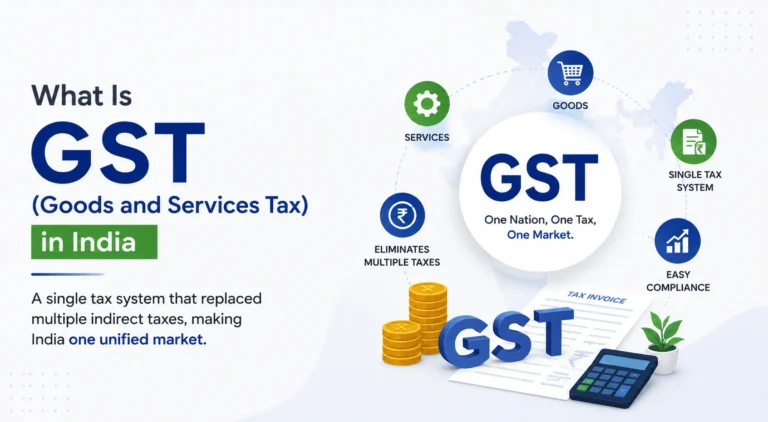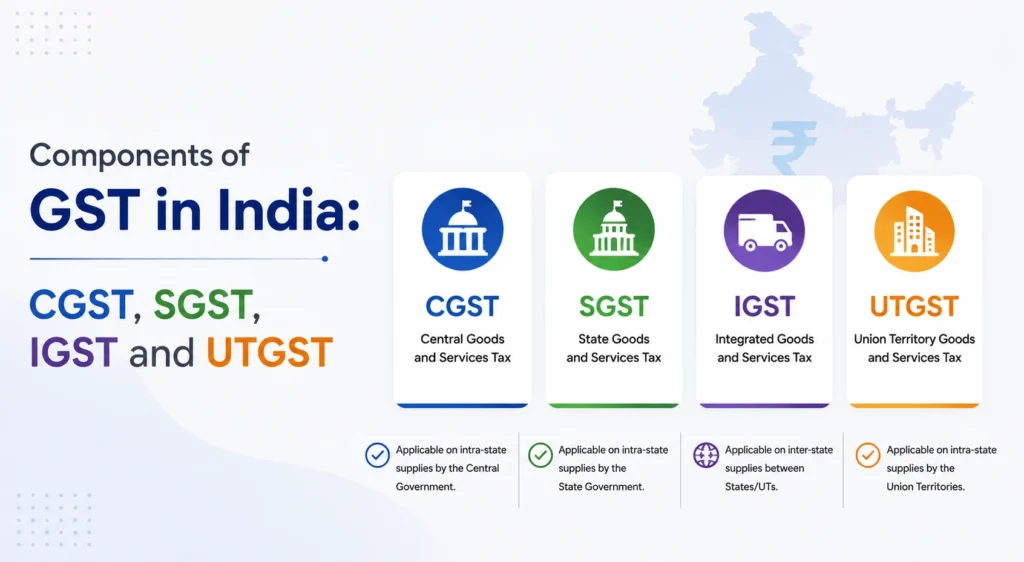
GST in India has four components: CGST, SGST, IGST and UTGST. CGST and SGST apply together on sales within a state, IGST applies on sales between states (and on imports), and UTGST replaces SGST in a handful of Union Territories. Which one you charge depends entirely on where the buyer and seller are located, not on what you’re selling.
Here’s how each one works, who collects it, and how the split actually plays out on an invoice.
Page Contents
What Are the 4 Components of GST?
GST works on a dual structure. Both the central government and the state (or Union Territory) government tax the same transaction, but under different names and different laws.
| Component | Full Form | Who Levies It | Applies To | Governing Act |
|---|---|---|---|---|
| CGST | Central Goods and Services Tax | Central government | Intra-state (within one state) | CGST Act, 2017 |
| SGST | State Goods and Services Tax | State government | Intra-state (within one state) | Respective State GST Act, 2017 |
| IGST | Integrated Goods and Services Tax | Central government | Inter-state, imports, exports | IGST Act, 2017 |
| UTGST | Union Territory Goods and Services Tax | UT administration | Intra-UT (in UTs without their own legislature) | UTGST Act, 2017 |
Splitting GST this way lets the centre and the states both collect revenue on the same sale, without taxing it twice. It also matches India’s federal structure, where states have historically had the power to tax sales within their own borders.
Which Taxes Did Each Component Replace?
| Transaction Type | Pre-GST Taxes | Post-GST Taxes |
|---|---|---|
| Sale within a state | VAT/Sales Tax + Central Excise or Service Tax | CGST + SGST |
| Sale to another state | Central Sales Tax (CST) + Central Excise or Service Tax | IGST |
Before July 2017, an inter-state sale meant dealing with Central Sales Tax on top of excise duty, with no credit flowing between the two. IGST folded both into one tax and, more importantly, built in a credit chain so tax paid at one stage isn’t lost by the time the goods reach the next state.
For the full forms and meanings of CGST and SGST specifically (in English and Hindi), see our CGST and SGST full form guide. For a deeper dive on IGST alone, see our IGST full form guide. For the bigger picture on GST registration, rates, and returns, see our complete GST guide.
CGST and SGST Full Form and Meaning
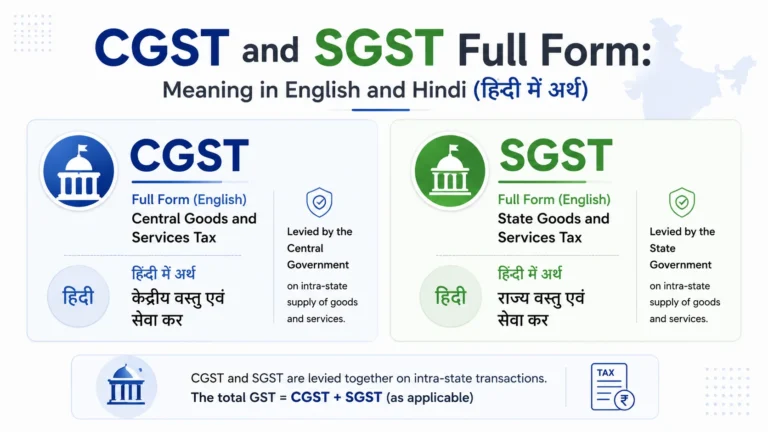
CGST stands for Central Goods and Services Tax, and SGST stands for State Goods and Services Tax. These two always travel together. Whenever a sale happens within one state, GST doesn’t get charged as one lump amount. It gets split down the middle: half goes to the centre as CGST, half goes to the state as SGST.
Say the GST rate on a product is 18%. That doesn’t mean you charge 18% CGST. You charge 9% CGST and 9% SGST, adding up to the same 18% total. The buyer never sees a difference in what they pay. The only thing that changes is how the tax gets divided between two governments.
CGST replaced central taxes like excise duty and service tax. SGST replaced state-level taxes like VAT, purchase tax, and luxury tax. So in a sense, CGST and SGST aren’t new taxes stacked on old ones. They’re the old taxes, merged and renamed under one system.
Worked Example: CGST and SGST on an Intra-State Sale
Rajesh runs a furniture shop in Pune and sells a table for ₹20,000 to a customer, also in Pune. GST rate: 18%.
| Item | Amount |
|---|---|
| Sale value | ₹20,000 |
| CGST (9%) | ₹1,800 |
| SGST (9%) | ₹1,800 |
| Total GST | ₹3,600 |
| Invoice total | ₹23,600 |
Of the ₹3,600 collected, ₹1,800 goes to the central government, and ₹1,800 goes to the Maharashtra government.
What Is IGST and When Does It Apply?
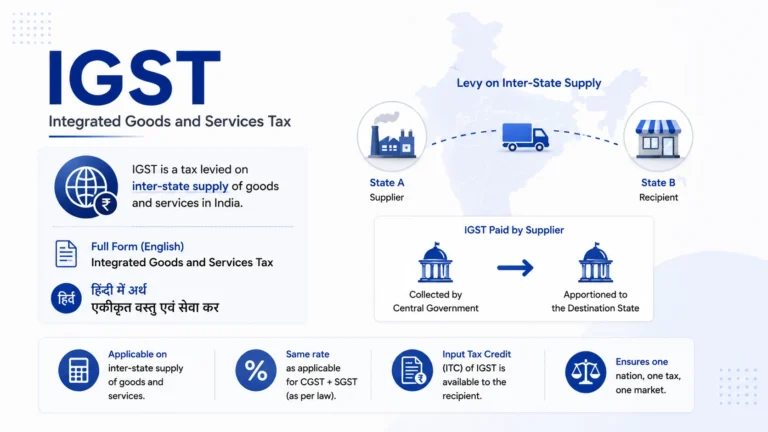
IGST stands for Integrated Goods and Services Tax. It applies whenever goods or services cross a state line, including imports into India and, in the case of exports, at a zero rate. Instead of splitting the tax into two parts like CGST and SGST, IGST is charged as one single amount equal to the full GST rate.
The central government collects IGST first, then shares the state’s portion with the destination state (the state where the goods or services are actually consumed, not where they were made). This is what makes GST a destination-based tax.
Worked Example: IGST on an Inter-State Sale
Priya, a wholesaler in Bengaluru, sells electronics worth ₹50,000 to a retailer in Hyderabad. GST rate: 18%.
| Item | Amount |
|---|---|
| Sale value | ₹50,000 |
| IGST (18%) | ₹9,000 |
| Invoice total | ₹59,000 |
The full ₹9,000 goes to the central government first. It’s then apportioned to Telangana (the destination state) based on where the goods are consumed.
What Is UTGST and Which Union Territories Use It?
UTGST stands for Union Territory Goods and Services Tax. It works exactly like SGST but applies only in Union Territories that don’t have their own elected legislature. In these UTs, CGST and UTGST are charged together on intra-UT sales, the same way CGST and SGST work in a state.
UTGST currently applies in:
- Chandigarh
- Andaman and Nicobar Islands
- Lakshadweep
- Dadra and Nagar Haveli and Daman and Diu
- Ladakh
Delhi, Puducherry, and Jammu & Kashmir are Union Territories too, but since they have their own legislature, SGST applies there instead of UTGST. This distinction trips a lot of people up, so it’s worth remembering: UTGST is about whether the UT has its own legislature, not just whether it’s technically a “state” or not.
CGST vs SGST vs IGST vs UTGST: Quick Comparison
| Feature | CGST + SGST | CGST + UTGST | IGST |
|---|---|---|---|
| Transaction type | Intra-state | Intra-UT (no legislature) | Inter-state, imports, exports |
| Collected by | Centre + State | Centre + UT administration | Centre (then shared with destination state) |
| Tax split | Split equally | Split equally | Charged as one combined rate |
| Governing law | CGST Act + State GST Act | CGST Act + UTGST Act | IGST Act |
How Input Tax Credit (ITC) Works Across These Components
This is where most GST explainers stop short, and it’s usually where businesses actually go wrong. You can’t freely move credit between CGST, SGST, and IGST. The law sets a strict order:
- IGST credit must be used first, against IGST liability. Whatever’s left over can then be used against CGST or SGST/UTGST liability, in any order.
- CGST credit can only be used against CGST liability, and after that, against IGST liability. It cannot be used to pay SGST or UTGST.
- SGST or UTGST credit can only be used against SGST/UTGST liability, and after that, against IGST liability. It cannot be used to pay CGST.
In practice, this means CGST and SGST credit are kept in completely separate lanes. A common mistake newer businesses make is assuming leftover CGST credit can quietly cover an SGST shortfall. It can’t, and trying to offset it that way will get flagged during return filing.
How Credit Actually Moves Between States: A Two-Stage Example
The rules above make more sense when you follow one product through two sales instead of one.
Stage 1 (intra-state): A manufacturer in Karnataka sells raw material to a trader, also in Karnataka, for ₹50,000. GST is 18%, so the trader pays ₹4,500 CGST and ₹4,500 SGST, a total of ₹9,000. The trader can claim this full ₹9,000 as input tax credit.
Stage 2 (inter-state): The same trader sells the finished product to a buyer in Telangana for ₹80,000. GST is 18%, so IGST of ₹14,400 applies. The trader now uses the ₹9,000 credit sitting from Stage 1 (both the CGST and SGST portions can be applied against IGST liability) and pays only the remaining ₹5,400 in cash.
Behind the scenes, since ₹4,500 of that credit came from SGST, Karnataka transfers that amount to the central government during settlement, because the credit that originated from an intra-state sale ended up covering an inter-state tax bill. This settlement between states is exactly why the government built the IGST mechanism to track credit across state lines in the first place.
Who Decides the CGST-SGST Split? The GST Council
The GST Council is the body that actually sets GST rates and, by extension, decides how the CGST/SGST/IGST split works in practice. It’s a joint forum of the central and state governments, chaired by the Union Finance Minister, with a finance or taxation minister nominated by every state and Union Territory as members.
Voting isn’t one-member-one-vote. The central government’s vote carries one-third weightage, and all the state governments together carry the remaining two-thirds. Any decision needs at least three-fourths of the weighted votes cast to pass. This structure is what keeps rate changes (like the move to the 0/5/18/40% slabs) a joint Centre-state decision rather than something either side can push through alone.
Recent Changes to CGST and IGST Rules Worth Knowing
A few amendments to the CGST Act and IGST Act took effect on 1 November 2024 that shift how some of this plays out in practice:
- Alcohol and rectified spirit are now outside GST entirely. Undenatured extra neutral alcohol and rectified spirit used for human consumption were removed from GST’s scope and are taxed under state excise laws instead, not CGST/SGST or IGST.
- Self-invoicing under Reverse Charge Mechanism (RCM) now has a deadline. If you receive a supply where you’re liable to pay tax under RCM, you must issue a self-invoice within 30 days of receiving the goods or services.
- IGST refunds are restricted for goods that attracted export duty, including exports to SEZs, to prevent claiming a refund and an export duty benefit on the same goods.
- Transitional credit on pre-GST service invoices is now allowed with proper documentation, letting businesses recover eligible credit from before July 2017 that was previously stuck.
None of these change how CGST, SGST, IGST, or UTGST are calculated day to day, but they affect specific situations (liquor-adjacent businesses, RCM transactions, and exporters) worth knowing if they apply to you.
GST Rate Slabs After GST 2.0
Following the GST Council’s rate rationalisation that took effect on 22 September 2025, GST rates now sit under four slabs: 0%, 5%, 18%, and 40% (the 40% slab applies to select demerit and luxury goods). Whichever slab a product or service falls under, that’s the total rate. CGST, SGST, IGST, and UTGST are just different ways of splitting or applying that same rate depending on where the transaction happens.
Common Mistakes to Avoid
A few things worth flagging from a compliance standpoint:
- Charging CGST + SGST on an inter-state invoice, or IGST on an intra-state one, is one of the most common invoicing errors and it invalidates the buyer’s input tax credit claim.
- Assuming UTGST and SGST are interchangeable on paper. They’re not the same line item, even though the math works out the same.
- Forgetting that GSTIN state codes, not the seller’s registered office, determine whether a sale is intra-state or inter-state.
Frequently Asked Questions
What is the full form of CGST and SGST? CGST stands for Central Goods and Services Tax, and SGST stands for State Goods and Services Tax. Both apply together on sales made within the same state.
What are the components of GST in India? GST has four components: CGST, SGST, IGST, and UTGST. CGST and SGST apply to intra-state sales, IGST applies to inter-state sales and imports, and UTGST applies to sales within specific Union Territories.
Why is GST split into CGST, SGST, IGST, and UTGST instead of one single tax? Because India has a federal structure where both the central and state governments have the right to tax. Splitting GST this way lets both collect revenue on the same transaction without double taxing the buyer.
Is UTGST the same as SGST? They work the same way and are calculated identically, but UTGST applies only in Union Territories without their own legislature, while SGST applies in states and in the three UTs (Delhi, Puducherry, J&K) that do have a legislature.
How does GST apply to e-commerce sales? If the buyer and seller are in the same state, CGST and SGST apply. If they’re in different states, IGST applies instead.
Can I use CGST input credit to pay SGST liability? No. CGST credit can only offset CGST liability first, then IGST liability. It cannot be used against SGST or UTGST, and the reverse is also true.
Is GST applicable on exports? Exports are treated as zero-rated supplies under GST. No tax is charged on the export itself, and exporters can claim a refund of the input tax credit involved.
What happens if I sell goods within a Union Territory like Chandigarh? Since Chandigarh has no legislature of its own, a sale within Chandigarh attracts CGST and UTGST, not CGST and SGST. The UTGST portion goes to the Chandigarh administration instead of a state government, but the calculation works exactly the same way.
Disclaimer: This article is for general informational purposes only and does not constitute tax or financial advice. GST rates, rules, and thresholds are subject to change by the GST Council. Please consult a qualified tax professional or refer to official government sources before making any tax-related decisions.