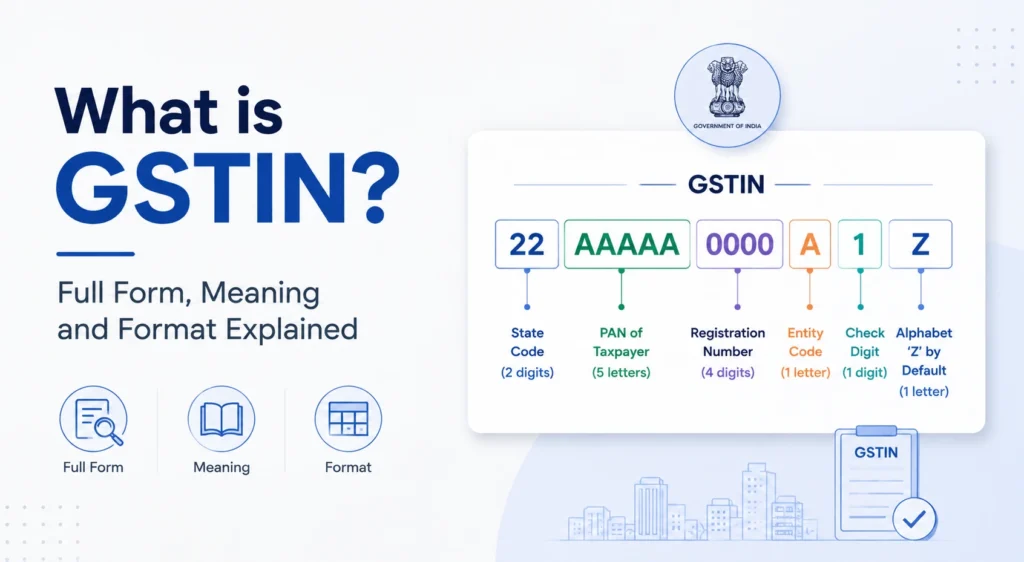
GSTIN stands for Goods and Services Tax Identification Number. It’s a unique 15-digit alphanumeric code that the GST system assigns to every business registered under GST in India. If you’re GST-registered, this number is your tax identity: it goes on every invoice, every return, and every e-way bill you generate.
Page Contents
What Does GSTIN Stand For?
GSTIN means Goods and Services Tax Identification Number. It’s issued under Section 25 of the Central Goods and Services Tax Act, 2017, the moment your GST registration is approved.
Before GST rolled out in 2017, a business dealing in goods had a VAT-era TIN from the state government, and a business providing services had a separate service tax number from the central government. GSTIN replaced both with one number, valid across the country, built on top of the business’s existing PAN.
In short: your GSTIN is proof that you’re a legally recognised GST taxpayer, and it’s what ties every transaction you make back to your business under the GST system.
GSTIN Format: How to Read the 15-Digit Number
A GSTIN isn’t a random string. Each of its 15 characters carries a specific piece of information, and once you know the pattern, you can read most of it at a glance.
| Position | Characters | What It Represents | Example |
|---|---|---|---|
| 1-2 | 2 digits | State code where the business registered | 27 = Maharashtra |
| 3-12 | 10 characters | PAN of the registered business or individual | ABCDE1234F |
| 13 | 1 character | Entity number (registrations in that state under the same PAN) | 1 |
| 14 | 1 character | Fixed character, always “Z” | Z |
| 15 | 1 character | Check character, auto-generated for validation | 6 |
Worked Example: Decoding a Real GSTIN
Take the GSTIN 27ABCDE1234F1Z6:
- 27 tells you the business registered in Maharashtra.
- ABCDE1234F is the PAN of the business or proprietor. This is also a quick way to sanity-check a GSTIN: if the middle 10 characters don’t match the PAN on file, something’s off.
- 1 means this is the first GST registration this PAN has taken in Maharashtra.
- Z is fixed, reserved for future use, and doesn’t change from one GSTIN to the next.
- 6 is the check character. It’s calculated from the first 14 characters using a checksum formula, so even a single wrong digit earlier in the number will usually produce a mismatch here, and the GST portal will flag the GSTIN as invalid.
This is also why a small typo in a GSTIN, say on a purchase invoice, doesn’t just look wrong: it actively fails validation, and that can hold up your buyer’s input tax credit.
GST State Codes: Full List
Since the first two digits map directly to a state or Union Territory, you can tell where any business registered just by reading the prefix. This is separate from where the business physically operates day to day; it only reflects where the GST registration was granted, which matters when you’re working out whether CGST plus SGST or IGST applies to a transaction.
| Code | State / UT | Code | State / UT |
|---|---|---|---|
| 01 | Jammu and Kashmir | 20 | Jharkhand |
| 02 | Himachal Pradesh | 21 | Odisha |
| 03 | Punjab | 22 | Chhattisgarh |
| 04 | Chandigarh | 23 | Madhya Pradesh |
| 05 | Uttarakhand | 24 | Gujarat |
| 06 | Haryana | 26 | Dadra and Nagar Haveli and Daman and Diu |
| 07 | Delhi | 27 | Maharashtra |
| 08 | Rajasthan | 29 | Karnataka |
| 09 | Uttar Pradesh | 30 | Goa |
| 10 | Bihar | 31 | Lakshadweep |
| 11 | Sikkim | 32 | Kerala |
| 12 | Arunachal Pradesh | 33 | Tamil Nadu |
| 13 | Nagaland | 34 | Puducherry |
| 14 | Manipur | 35 | Andaman and Nicobar Islands |
| 15 | Mizoram | 36 | Telangana |
| 16 | Tripura | 37 | Andhra Pradesh |
| 17 | Meghalaya | 38 | Ladakh |
| 18 | Assam | ||
| 19 | West Bengal |
Codes 25 and 28 are legacy references (old Daman and Diu, and old undivided Andhra Pradesh) and don’t apply to current registrations. If a GSTIN you’re checking starts with one of these, treat it as an old record rather than a live one.
GSTIN vs GSTN: What’s the Difference
These two get mixed up constantly, but they’re not related in the way the similar names suggest.
| GSTIN | GSTN | |
|---|---|---|
| Full form | Goods and Services Tax Identification Number | Goods and Services Tax Network |
| What it is | A 15-digit number given to a taxpayer | The organisation that runs the GST portal’s IT infrastructure |
| Who has it | Every GST-registered business | It’s an entity, not a number assigned to anyone |
| What it’s used for | Invoicing, returns, ITC, e-way bills | Building and maintaining the GST portal, return filing system and e-invoice network |
Put simply, GSTIN is your number, and GSTN is the organisation behind the system that issues and manages it.
GSTIN vs PAN: What’s the Difference
A GSTIN is built on top of a PAN, which is part of why people conflate the two.
PAN (Permanent Account Number) is a 10-character code issued by the Income Tax Department, and it identifies a person or entity for income tax purposes. GSTIN is a separate 15-character code issued specifically for GST compliance, and digits 3 to 12 of it are literally your PAN.
The practical difference: you use PAN for income tax filings and most financial transactions, and you use GSTIN specifically for GST invoices, returns and input tax credit. One PAN can also sit behind multiple GSTINs, since a business with operations in more than one state needs a separate GSTIN for each state, even though the PAN stays the same throughout.
GSTIN vs UIN: What’s the Difference
UIN, or Unique Identification Number, looks similar to a GSTIN but serves a narrower purpose. It’s issued to specific notified entities, such as foreign embassies, UN bodies and consulates, that don’t pay GST themselves but can claim refunds on GST they’ve been charged.
| GSTIN | UIN | |
|---|---|---|
| Issued to | Regular taxpayers and businesses | Embassies, UN bodies and notified organisations |
| Purpose | Tax collection and compliance | Claiming GST refunds |
| Can claim ITC | Yes | No, only refunds |
| Regular return filing | Yes | No |
If you ever come across a “GSTIN/UIN” field on the GST portal’s search tool, that’s why: both are searched the same way, but they’re issued for very different reasons.
GSTIN vs TIN: What’s the Difference
TIN, or Taxpayer Identification Number, was the identifier used under the old VAT system, before GST existed. If you’re dealing with an older business or an old invoice, you might still come across one.
| GSTIN | TIN | |
|---|---|---|
| Full form | Goods and Services Tax Identification Number | Taxpayer Identification Number |
| Issued by | GST system, based on PAN | State Commercial Tax Departments |
| Length | 15 characters | 11 digits (format varied by state) |
| Current status | Active, used for all GST compliance | Discontinued for GST purposes since 2017 |
| Contains PAN | Yes, digits 3-12 | No |
TIN numbers from the VAT era carry no weight under GST. If a supplier only gives you a TIN and no GSTIN, that’s a sign they haven’t migrated to GST registration, and you should ask for their GSTIN before treating the transaction as GST-compliant.
GSTIN Status: Active, Cancelled, Suspended and What Each Means
A GSTIN that’s correctly formatted isn’t necessarily one you should transact with. The portal also shows a status, and that status changes what you can safely do with it.
| Status | What It Means | Can You Claim ITC on Purchases From This GSTIN? |
|---|---|---|
| Active | Registration is valid and in good standing | Yes, subject to the usual ITC conditions |
| Provisional | Temporary status issued during migration or early registration | Generally not yet, wait for full activation |
| Suspended | Registration is temporarily blocked, usually pending an issue | Risky, best avoided until resolved |
| Cancelled | Registration has been formally withdrawn, voluntarily or by the department | No, ITC risk is very high |
| Inactive | Registration exists but isn’t currently operational | Avoid transacting until status is confirmed active |
Why a GSTIN gets suspended: a mismatch between GSTR-1 and GSTR-3B figures, returns not filed for a while, suspected fraud, a mismatch between e-way bill data and returns, or a show-cause notice in progress.
Why a GSTIN gets cancelled: returns not filed for six or more consecutive months, registration obtained through fraud or misrepresentation, the business shutting down or being transferred, violating GST provisions, or the taxpayer cancelling it voluntarily.
If your own GSTIN gets suspended or cancelled, it can be reactivated by filing an application for revocation (Form GST REG-21) within 30 days, clearing any pending returns and dues, and waiting for the officer’s approval. This is a compliance process in its own right, so if you’re dealing with a live suspension or cancellation, it’s worth getting a professional involved rather than working purely from a checklist.
Who Needs a GSTIN
Most businesses need a GSTIN once they cross a turnover threshold, and a few categories need one regardless of turnover.
| Category | Threshold for Goods | Threshold for Services |
|---|---|---|
| Normal category states | ₹40 lakh | ₹20 lakh |
| Special category states | ₹20 lakh (some states ₹10 lakh) | ₹10 lakh |
Regardless of turnover, GSTIN is compulsory for e-commerce sellers, casual taxable persons, non-resident taxable persons, anyone required to deduct TDS or collect TCS under GST, and Input Service Distributors. If none of these apply and you’re under the threshold, you can still register voluntarily, mainly to claim input tax credit and to look GST-registered to B2B buyers.
What Happens If You Operate Without a GSTIN
If your business is liable to register but hasn’t, GST law treats this as non-compliance, not just an oversight. Two penalty situations come up most often:
- Liable but unregistered: a penalty of 10% of the tax due, or ₹10,000, whichever is higher.
- Collected GST but didn’t deposit it: a penalty of 100% of the tax amount involved.
Beyond the direct penalty, operating without a GSTIN when you’re required to have one also means you can’t legally collect GST from customers, can’t issue a valid tax invoice, and can’t onboard as a seller on most marketplaces, since platforms like Amazon and Flipkart check GSTIN at seller registration.
How to Get a GSTIN (and What It Costs)
Getting a GSTIN is part of GST registration, and it’s entirely free. There’s no government fee at any stage, whether you apply through the GST portal (gst.gov.in) or at a GST Seva Kendra in person. The only cost you might incur is a service fee if you hire a professional or consultant to handle the paperwork for you.
At a high level, registration involves submitting your PAN, business and promoter details, and supporting documents through the portal, after which you receive a Temporary Reference Number (TRN), then an Application Reference Number (ARN) once you submit the full form, and finally your GSTIN once the application is approved. The document checklist and full walkthrough are detailed enough to deserve a dedicated guide rather than a summary here.
How to Find or Verify a GSTIN
There are three ways to look up a GSTIN, depending on what information you’re starting with.
If you already have the GSTIN, and want to confirm it’s genuine:
- Go to gst.gov.in.
- Click Search Taxpayer, then Search by GSTIN/UIN.
- Enter the 15-digit number and the captcha code.
- Check the result against what’s on the invoice: legal name, registration status, and state code.
If you only have the business’s PAN: Go to Search Taxpayer → Search by PAN on the same portal. It returns every GSTIN registered against that PAN, which is useful when a business has multiple state registrations and you’re not sure which one applies to your transaction.
If you only have the business name: Use Search Taxpayer, enter the legal name (as it appears on PAN or incorporation records, not just the brand name), and filter by state if you get too many results. If nothing comes up, the business may be unregistered, or may have registered too recently for the search index to reflect it, in which case ask them directly for their GST registration certificate.
None of this needs a login, and all three methods are free. If the legal name on the portal doesn’t match the name on the invoice, or the status shows anything other than Active, follow up before relying on that GSTIN for input tax credit.
Where GSTIN Also Shows Up in GST Compliance
Once you’re registered, your GSTIN keeps showing up across GST processes beyond the basics covered here:
- On every invoice: both your GSTIN and your buyer’s GSTIN are mandatory fields on a B2B tax invoice. A wrong digit on either side can stop the invoice from reconciling.
- In e-invoicing: if your turnover crosses the applicable threshold, your GSTIN is validated by the government’s Invoice Registration Portal every time you generate an e-invoice, and it’s embedded in the resulting QR code.
- In ITC matching: your GSTIN is the identifier the GST system uses to match your purchases against your suppliers’ filed returns in GSTR-2B, which is what determines whether your input tax credit actually goes through.
- Under the Composition Scheme: composition dealers still get a GSTIN, but they can’t collect GST or issue a full tax invoice, and their buyers can’t claim ITC on those purchases.
Each of these is a deeper topic in its own right and worth reading up on separately if it applies to you.
A Common Mistake Businesses Make With GSTIN
One thing that trips up a lot of new businesses: they assume a GSTIN issued in one state automatically covers sales anywhere in India. It doesn’t. GST registration is state-specific, so if you open a warehouse or start operating in a second state, you need a fresh GSTIN for that state too, even though it’s built on the same PAN. Businesses that skip this step usually find out the hard way, when invoices from the new location don’t reconcile properly against any registered GSTIN.
FAQs
What is the full form of GSTIN? GSTIN stands for Goods and Services Tax Identification Number, the 15-digit code assigned to every GST-registered business in India.
What does GSTIN mean for a business? It’s the business’s official tax identity under GST. It’s required on invoices, returns, e-way bills and input tax credit claims.
How many digits does a GSTIN have? 15. The first 2 are the state code, the next 10 are the PAN, the 13th is the entity number, the 14th is a fixed “Z”, and the 15th is a check character.
Is GSTIN the same as a GST number? Yes. “GST number” and “GSTIN” refer to the same 15-digit identifier.
Can two businesses have the same GSTIN? No. Each GSTIN is unique to one PAN and one state combination, along with an entity number if there’s more than one registration for that PAN in that state.
Is GSTIN and PAN the same thing? No. PAN is a 10-character income tax identifier, and it’s embedded inside the GSTIN, but GSTIN is a separate 15-character number used only for GST purposes.
What is the difference between GSTIN and UIN? GSTIN is issued to regular taxpayers for GST compliance. UIN is issued to embassies, UN bodies and similar notified entities that only need to claim GST refunds, not file regular returns.
Is GSTIN free to get? Yes. GST registration and the GSTIN it produces are free through the official GST portal. You’d only pay if you hire someone to handle the application for you.
What does it mean if a GSTIN shows as Suspended? It means the registration is temporarily blocked, usually due to a returns mismatch, non-filing, or a pending compliance issue. Transacting with a suspended GSTIN carries ITC risk until it’s resolved.
What does it mean if a GSTIN is Cancelled? The registration has been formally withdrawn, either by the taxpayer or by the department. You shouldn’t claim ITC on invoices from a Cancelled GSTIN.
Can I search for a GSTIN using just a PAN or business name? Yes. The GST portal supports searching by GSTIN/UIN, by PAN, or by the registered business name, so you’re not limited to only looking it up if you already have the exact number.
What’s the difference between GSTIN and TIN? TIN was the 11-digit identifier used under the pre-GST VAT system. It’s no longer valid for GST purposes. GSTIN replaced it with a single 15-digit number valid nationwide.
What happens if I don’t register for GST when I’m required to? You risk a penalty of 10% of the tax due or ₹10,000, whichever is higher, and if you’ve collected GST without depositing it, the penalty rises to 100% of that amount.
Disclaimer: This article is for general informational purposes only and does not constitute tax or legal advice. GST rules, thresholds and procedures can change; please verify current provisions on gst.gov.in or consult a qualified tax professional before making compliance decisions.
Read More: How to Download GST Order and Notice from the Portal 2026