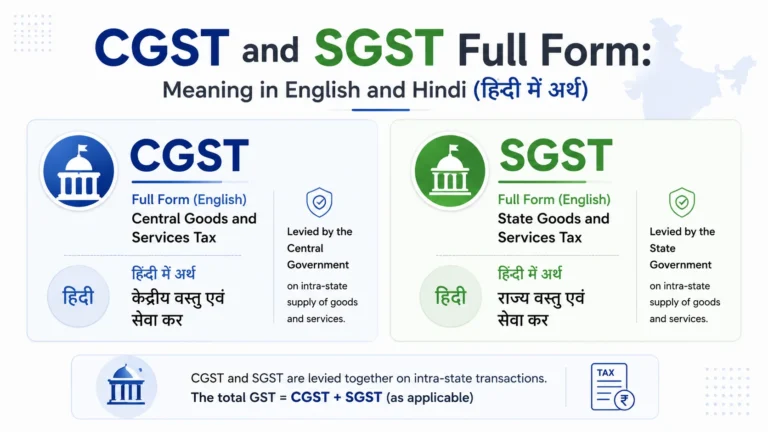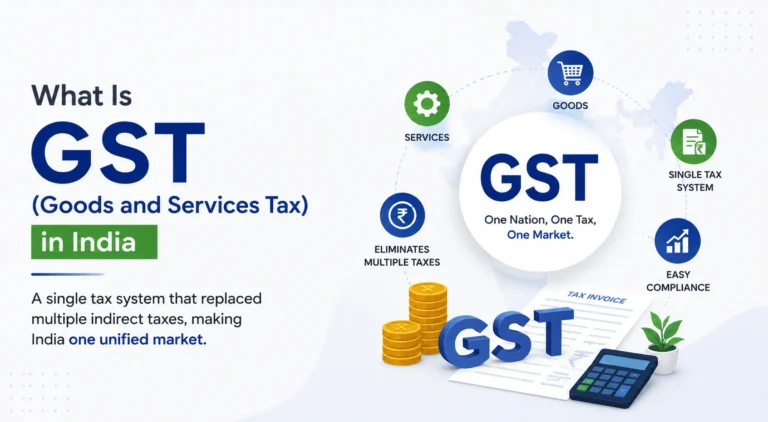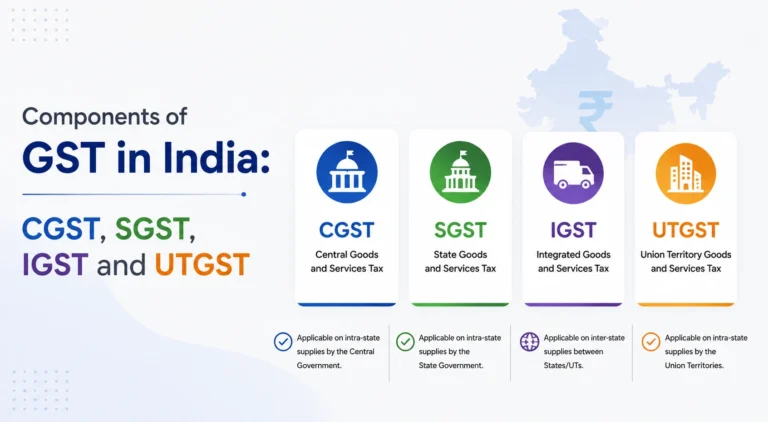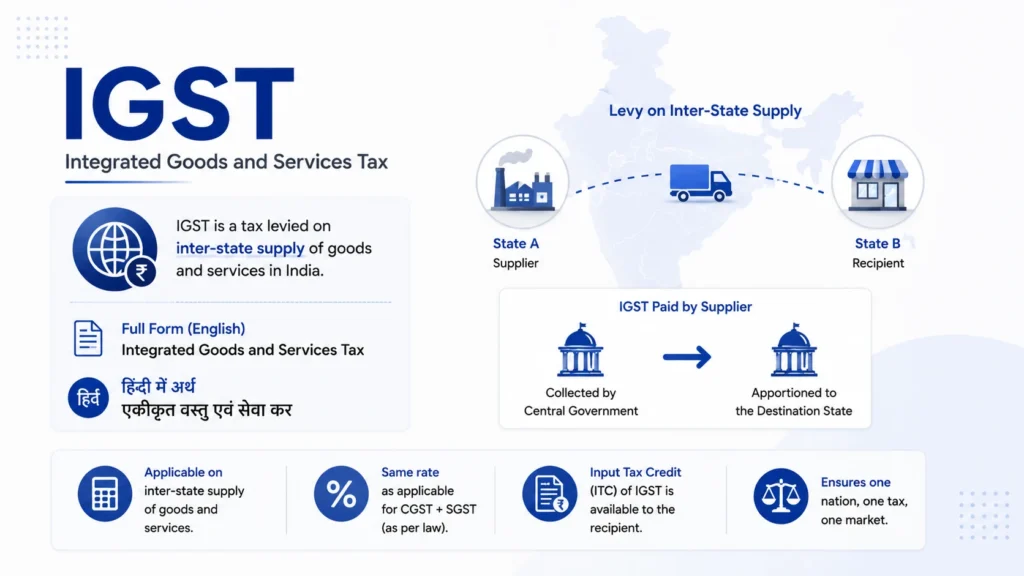
IGST stands for Integrated Goods and Services Tax. It’s the GST charged on any sale of goods or services between two different states, on imports into India, and on exports (at a zero rate). Unlike CGST and SGST, which split a sale’s tax into two equal halves, IGST is charged as one single combined amount, and the central government collects and later distributes it.
Page Contents
What Does IGST Stand For?
IGST is short for Integrated Goods and Services Tax, governed by the IGST Act, 2017. The word “integrated” is the key part of the name: IGST isn’t a separate tax bolted onto CGST and SGST, it’s essentially the two of them combined into a single rate for transactions that cross a state border.
If the combined GST rate on a product is 18%, an intra-state sale splits that into 9% CGST and 9% SGST. An inter-state sale of the same product charges the full 18% as IGST instead, with no split at the invoicing stage.
When Does IGST Apply?
IGST applies in these situations:
- Sale of goods or services from one state to another
- Imports of goods or services into India
- Exports of goods or services (charged at 0%, as a zero-rated supply)
- Supplies to or from a Special Economic Zone (SEZ)
- Stock transfers between a business’s own branches in different states, even though no actual sale takes place
- Supplies where the place of supply can’t be pinned to a single state (in which case revenue is split equally among the states involved)
If you’re unsure whether a transaction is inter-state or intra-state, the answer usually comes down to the supplier’s location versus the place of supply, which for goods is typically the delivery address and for services depends on where the recipient is registered.
A useful shortcut for the rate itself: IGST = CGST + SGST. If a product attracts 9% CGST and 9% SGST on an intra-state sale, the same product attracts 18% IGST on an inter-state sale, since IGST is simply the two combined into a single line item.
A Note on Stock Transfers
This one catches businesses off guard more than any other item on this list. If your Bengaluru warehouse sends inventory to your own branch in Pune, no sale has technically happened, but GST law still treats it as a supply, so IGST applies. The receiving branch can claim this as input tax credit later, so it isn’t a real cost, but it does mean paperwork and cash flow that many businesses don’t plan for.
How IGST Is Collected and Shared
The central government collects the full IGST amount at the time of the transaction. It then transfers the state’s portion to the destination state, meaning the state where the goods or services are actually consumed, not where they were produced or shipped from. This is what keeps GST a destination-based tax even on transactions that cross state lines.
In practice, this apportionment happens through the GST settlement mechanism between the centre and the states, so businesses don’t need to calculate or manage this split themselves. You just charge IGST at the applicable rate, and the government handles the rest.
IGST vs CGST vs SGST
| Feature | IGST | CGST + SGST |
|---|---|---|
| Applies to | Inter-state sales, imports, exports | Intra-state sales only |
| Tax structure | One combined rate | Split equally into two |
| Collected by | Central government | Central + state government separately |
| Governing law | IGST Act, 2017 | CGST Act + respective State GST Act, 2017 |
| Revenue distribution | Centre transfers state’s share to destination state | Central and state shares collected directly |
For a full breakdown of how CGST and SGST work together on intra-state sales, see our CGST and SGST full form guide. For the bigger picture on GST registration, rates, and returns, see our complete GST guide.
Worked Example: IGST Calculation
A trader in Chennai, Tamil Nadu, sells electronics worth ₹1,00,000 to a buyer in Mumbai, Maharashtra. The applicable GST rate is 18%.
| Item | Amount |
|---|---|
| Sale value | ₹1,00,000 |
| IGST (18%) | ₹18,000 |
| Invoice total | ₹1,18,000 |
The full ₹18,000 goes to the central government first. Roughly half is retained centrally, and the remainder is transferred to Maharashtra, the destination state where the goods are consumed. As the seller, you don’t calculate this split yourself, you simply charge 18% IGST on the invoice.
IGST on Imports and Exports
Imports: Goods and services brought into India are treated as inter-state supplies, so they attract IGST in addition to any customs duty. This IGST is generally available as input tax credit for a registered business.
Exports: Exports are treated as zero-rated supplies. You have two options as an exporter:
- Export under a Letter of Undertaking (LUT) without paying IGST, and later claim a refund of the accumulated input tax credit.
- Pay IGST on the export and claim it back as a refund afterward, under Rule 96 of the CGST Rules, which specifically governs IGST refunds on exported goods and services.
Either way, refunds are filed through Form RFD-01 on the GST portal, along with supporting shipping and invoice documentation. Most exporters prefer the LUT route since it avoids blocking working capital in an upfront tax payment that gets refunded later, sometimes only after weeks of processing.
Input Tax Credit (ITC) Under IGST
IGST credit has the widest usage of the three. It can be used to pay off IGST liability first, and whatever’s left over can then be applied against CGST or SGST/UTGST liability, in either order. This is broader than CGST or SGST credit, which are each restricted to their own tax type plus IGST.
This wider flexibility is part of why IGST credit is used up first in the ITC set-off order: the law requires you to exhaust IGST credit before touching CGST or SGST credit, to keep the overall credit chain moving efficiently between states.
Common Mistakes to Avoid
- Charging CGST and SGST on a sale that’s actually inter-state (or the reverse). This is one of the most common invoice errors, and it’s more painful to fix than it sounds. Under Section 19 of the IGST Act, you can’t simply “transfer” the wrongly paid CGST/SGST into IGST. You have to pay the correct IGST in full, out of pocket, and then separately apply for a refund of the tax you paid under the wrong head. That gap can tie up working capital for weeks while the refund is processed.
- Forgetting that supplies to SEZ units are treated as inter-state, even if the SEZ happens to be in the same state as the supplier.
- Assuming exports need IGST paid upfront. Most exporters can avoid this entirely by filing a LUT.
- Skipping the e-way bill on inter-state shipments. Any movement of goods worth more than ₹50,000 needs a valid e-way bill, and if the IGST amount shown on it doesn’t match the tax invoice, the shipment can get held up at a checkpoint.
Frequently Asked Questions
What is the full form of IGST? IGST stands for Integrated Goods and Services Tax. It applies to sales between states, imports, and exports.
What is IGST in simple terms? IGST is the GST charged when a sale crosses a state border, combining what would otherwise be separate CGST and SGST into one tax, collected by the central government and shared with the state where the goods or services are consumed.
Is IGST the same as CGST plus SGST? In terms of the total rate, yes. If the combined GST rate is 18%, IGST is charged as a flat 18%, matching what CGST (9%) and SGST (9%) would add up to on an intra-state sale.
Who collects IGST? The central government collects IGST, then transfers the appropriate share to the destination state based on where the goods or services are consumed.
Can IGST credit be used to pay CGST or SGST? Yes. IGST credit can be used against IGST liability first, and any remaining balance can be applied to either CGST or SGST liability, in any order.
Is IGST applicable on exports? Exports are zero-rated under GST. Exporters can either export without paying IGST using a Letter of Undertaking, or pay IGST and claim a refund afterward under Rule 96.
Does IGST apply if I move goods to my own branch in another state? Yes. Even without an actual sale, transferring stock between a business’s own branches in different states is treated as a supply under GST law, so IGST applies. The receiving branch can claim it back as input tax credit.
Disclaimer: This article is for general informational purposes only and does not constitute tax or financial advice. GST rates and rules are set by the GST Council and are subject to change. Please consult a qualified tax professional or refer to the official GST portal before making any compliance decisions.