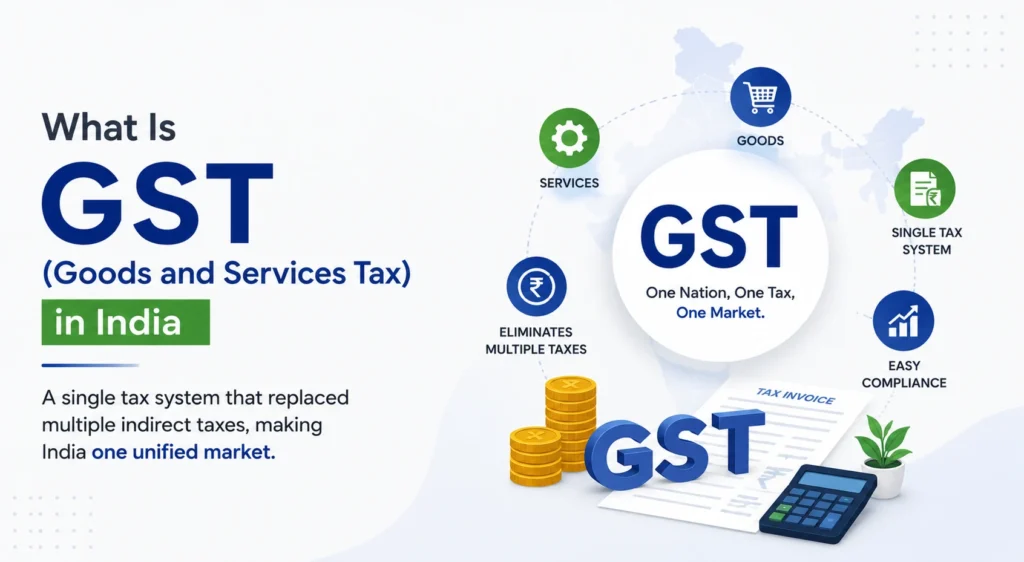
GST, or Goods and Services Tax, is a single indirect tax charged on the supply of goods and services in India. It replaced older taxes like excise duty, service tax, and VAT with one unified system, and it lets businesses claim credit for the tax they’ve already paid on purchases, so tax doesn’t pile up on tax at every stage.
GST was rolled out on 1 July 2017, through the 101st Constitutional Amendment Act, which gave both Parliament and state legislatures the power to tax the same transaction simultaneously. 1 July is now marked as GST Day each year.
Here’s everything that sits under that definition: how GST is structured, who needs to register, what it costs, and the terms you’ll run into once you’re dealing with it regularly.
Page Contents
GST Full Form and Meaning
The full form of GST is Goods and Services Tax. It’s called that because it applies to both goods (physical products) and services (things like consulting, repairs, or software subscriptions) under one law, instead of taxing them separately the way India used to.
GST is also a destination-based tax. That means the tax revenue goes to the state where the goods or services are actually consumed, not the state where they were manufactured or the service provider is based.
Why Was GST Introduced?
Before July 2017, a single product could be taxed by the central government (excise duty), the state government (VAT), and sometimes a local body (entry tax), all at different stages. GST replaced this stack with one tax, for a few clear reasons:
- To stop tax being charged on tax (the “cascading effect”)
- To bring every state onto the same tax structure, instead of 29 different VAT systems
- To move compliance online, from registration to return filing
- To make it easier for businesses to sell across state lines without different tax rules at every border
What Does GST Include (and What’s Left Out)?
GST applies to nearly every supply of goods and services in India, sale, transfer, lease, barter, or import. But a handful of items are still deliberately kept outside GST and taxed separately:
- Alcohol for human consumption – still taxed by states through their own excise duty and VAT, not GST.
- Petroleum products – crude oil, petrol, diesel, natural gas, and aviation turbine fuel are constitutionally included under GST’s definition of goods, but the GST Council hasn’t yet notified a date to actually bring them under GST. States continue to charge VAT and the centre continues to charge excise duty on these in the meantime.
- Electricity – taxed separately by states, not under GST.
- Stamp duty and property registration – these remain a state subject, outside GST entirely.
- Securities transactions – governed by Securities Transaction Tax (STT), not GST.
Tobacco products are a partial exception: they’re taxed under GST (in the 40% slab) and the central government also levies a separate excise duty on top, so tobacco effectively carries two layers of tax.
Everything else, from a haircut to a smartphone to a consulting invoice, falls under GST’s scope, taxed under one of the four slabs covered below.
How Does GST Apply to Services?
GST treats goods and services under the same law, but classifies them differently on paper. Goods are identified using an HSN code, and services use a SAC (Services Accounting Code), which always starts with 99. Whether you’re a freelancer invoicing a client, a SaaS company billing a subscription, or a repair shop charging for labour, the same CGST/SGST or IGST logic applies based on where the buyer is located, not on what’s being sold.
Before GST, services were taxed separately under Service Tax at a flat rate. GST folded that into the same slab structure as goods, so a service can now fall under 0%, 5%, 18%, or 40%, depending on what it is, exactly like a physical product would.
Types (Components) of GST
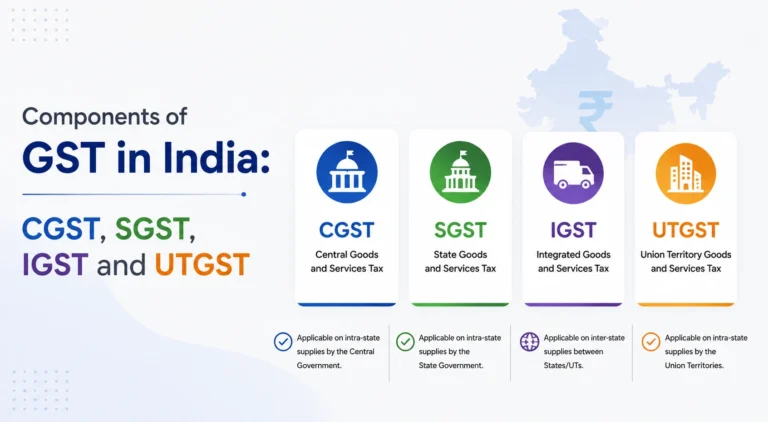
GST isn’t one flat tax. It splits into four components depending on where the transaction happens:
| Component | Full Form | Applies To | Collected By |
|---|---|---|---|
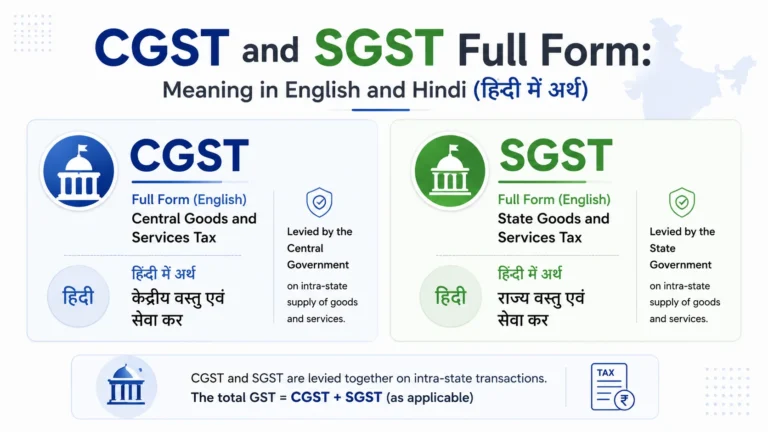
| CGST | Central Goods and Services Tax | Sales within a state | Central government |
| SGST | State Goods and Services Tax | Sales within a state | State government |
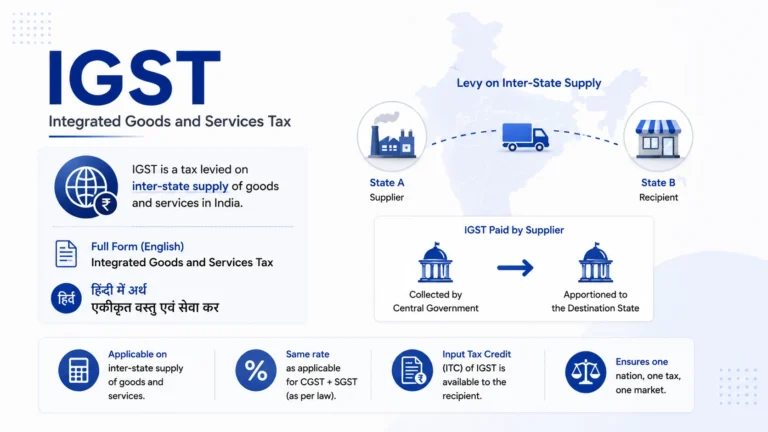
| IGST | Integrated Goods and Services Tax | Sales between states, imports | Central government (shared with destination state) |
| UTGST | Union Territory Goods and Services Tax | Sales within a Union Territory without its own legislature | UT administration |
| Compensation Cess | GST Compensation Cess | Select notified goods (like tobacco and aerated drinks), on top of the applicable slab | Central government |
A note on Compensation Cess: it’s not technically one of the four core components, but you’ll still see it applied to a narrow list of notified goods. Its role has shrunk significantly since the September 2025 rate rationalisation introduced the 40% slab, which now covers most of what the cess used to target, but it hasn’t been fully phased out for every category.
On a sale within one state, CGST and SGST apply together and split the tax equally. On a sale between two states, only IGST applies, charged as one combined amount. For a full breakdown with worked examples and how input tax credit moves between these four, see our detailed components of GST guide. If you specifically want the full forms and meanings of CGST and SGST (in English and Hindi), see our CGST and SGST full form guide, or for inter-state transactions, our IGST full form guide.
Who Needs GST Registration?
GST registration becomes mandatory once your turnover crosses a set threshold, and the threshold depends on whether you sell goods, services, or both, and which state you’re in.
| Business Type | Normal Category States | Special Category States* |
|---|---|---|
| Goods only | ₹40 lakh | ₹20 lakh |
| Services (or goods + services) | ₹20 lakh | ₹10 lakh |
*Special category states include Arunachal Pradesh, Manipur, Meghalaya, Mizoram, Nagaland, Sikkim, Tripura, and Uttarakhand.
Turnover here means aggregate turnover: every taxable supply, exempt supply, export, and inter-state supply, added up across your entire business under one PAN, not per state.
You must register regardless of turnover if you’re:
- An e-commerce operator or seller
- Making inter-state taxable supplies (with a few small-service-provider exceptions)
- A casual or non-resident taxable person
- Required to deduct TDS or collect TCS under GST
- Supplying online services from outside India to unregistered persons in India
How to Register for GST
- Go to the GST portal and start a new registration.
- Fill out Form GST REG-01 with your business and PAN details.
- Upload documents: PAN, address proof, bank account proof, and identity proof of the business owner(s).
- Complete Aadhaar or biometric verification, depending on your category.
- Once approved, you’ll receive your GSTIN and registration certificate.
GST Rates in India
Following the GST Council’s rate rationalisation that took effect on 22 September 2025, India now has four GST slabs: 0%, 5%, 18%, and 40% (the 40% slab is reserved for select demerit and luxury goods, like tobacco and high-end vehicles). Most everyday goods and services fall under 5% or 18%.
Quick calculation example: if a product costs ₹1,000 (taxable value) and the GST rate is 18%, the GST amount is ₹180, making the final price ₹1,180.
Because rates get revised periodically by the GST Council, always check the current rate for a specific item on the official GST portal rather than relying on a fixed list.
Rates aren’t set unilaterally. The GST Council, a joint body of the central and state finance ministers chaired by the Union Finance Minister, decides them together. For how that voting process actually works, see the GST Council section in our components of GST guide.
What Is GSTIN, HSN, and SAC?
GSTIN is the 15-digit unique number assigned to every business registered under GST. It appears on every invoice you issue and every return you file, and buyers use it to verify your registration and claim input tax credit.
HSN code classifies goods, and SAC code classifies services (SAC codes always start with 99). Both determine which GST rate applies to what you’re selling, so using the wrong code is one of the more common, and avoidable, invoicing mistakes.
How many digits you need depends on your turnover in the previous financial year:
| Aggregate Turnover | HSN/SAC Digits Required |
|---|---|
| Up to ₹5 crore, B2B invoices | 4 digits (mandatory) |
| Up to ₹5 crore, B2C invoices | Optional, though still recommended |
| Above ₹5 crore | 6 digits (mandatory on all invoices) |
| Exports and imports | 8 digits (mandatory) |
Getting the code wrong doesn’t just cause a filing headache. It can apply the wrong tax rate, freeze your buyer’s input tax credit claim, and attract a penalty of up to ₹50,000 under the CGST Act.
How Input Tax Credit (ITC) Works
ITC is what stops GST from stacking up at every stage of a supply chain. If you’ve paid GST on your business purchases, you can subtract that from the GST you owe on your sales.
Example: You collect ₹1,800 in GST from customers this month (output tax). You already paid ₹600 in GST on business purchases (input tax credit). You only pay the government the difference: ₹1,200.
To claim ITC, you generally need:
- A valid tax invoice from a GST-registered supplier
- The goods or services to have actually been received
- Your supplier to have filed their own GST returns correctly (mismatches block your credit)
One rule that trips people up: CGST credit can only be used against CGST or IGST liability, and SGST credit can only be used against SGST or IGST liability. You can’t use CGST credit to pay off an SGST bill, or the other way round.
GST Returns You’ll Likely File
| Return | What It Covers | Frequency |
|---|---|---|
| GSTR-1 | Details of outward supplies (sales) | Monthly or quarterly |
| GSTR-3B | Summary return with tax payment | Monthly or quarterly |
| GSTR-9 | Annual consolidated return | Yearly (where applicable) |
Missing a due date triggers a late fee, and if the tax payment itself is delayed, interest applies on top. Repeated non-compliance can escalate to a formal notice, so it’s worth building a monthly habit of reconciling your sales and purchase records before filing.
What a Valid GST Invoice Needs
A compliant tax invoice isn’t optional paperwork. It’s what your buyer needs to claim their own input tax credit. At minimum, it should include:
- Your business name and GSTIN
- Invoice number and date
- Buyer’s GSTIN (for B2B sales)
- Item description with HSN or SAC code
- Taxable value and GST rate
- The tax breakup (CGST/SGST or IGST, depending on the transaction)
- Place of supply
- Total invoice value
Other GST Terms Worth Knowing
Composition Scheme: A simplified option for small taxpayers (turnover up to ₹1.5 crore for goods, ₹50 lakh for services) that offers lower compliance and a flat tax rate, but restricts input tax credit.
Reverse Charge Mechanism (RCM): In specified cases, the buyer pays GST directly instead of the seller. This usually applies to certain notified goods, services, or transactions with unregistered suppliers.
E-invoicing: Eligible businesses (based on turnover thresholds set by the GST Council) must report invoices electronically to get an Invoice Reference Number (IRN) before the invoice is considered valid for B2B transactions.
E-way bill: An electronic permit required for moving goods worth more than ₹50,000, generally when the distance covered exceeds 10 km. It’s mandatory for inter-state movement and applies to most intra-state movement too, depending on the state. Each e-way bill stays valid for one day per 200 km travelled, and can be extended online before it expires if the shipment gets delayed.
Common Mistakes to Avoid
- Charging CGST and SGST on an inter-state sale (or IGST on an intra-state one). This invalidates the buyer’s ITC claim and needs a credit note to fix.
- Registering late after crossing the turnover threshold. You become liable for GST from the date you crossed it, not the date you registered, and you’ll owe interest on the gap.
- Assuming ITC applies automatically. If your supplier hasn’t filed their return correctly, your credit gets blocked even if you paid them in full.
Frequently Asked Questions
What is GST in simple words? GST is a single tax charged on the sale of goods and services in India, replacing older taxes like VAT and service tax. It’s collected at every stage of the supply chain, but businesses can claim credit for tax already paid, so only the value added at each stage gets taxed.
What is the full form of GST? GST stands for Goods and Services Tax.
Who needs to register for GST? Businesses that cross ₹40 lakh turnover (goods) or ₹20 lakh (services) in normal category states, along with anyone in a mandatory registration category like e-commerce sellers or inter-state suppliers, regardless of turnover.
What is the difference between CGST, SGST, and IGST? CGST and SGST apply together on sales within a state, splitting the tax between the central and state governments. IGST applies on sales between states and on imports, collected by the central government and shared with the destination state.
How is GST calculated? GST is calculated as a percentage of the taxable value of goods or services. For an 18% rate on a ₹1,000 item, GST comes to ₹180, making the total ₹1,180.
What happens if I don’t file my GST return on time? You’ll be charged a late fee, and if any tax payment is also overdue, interest applies on top of that. Continued non-filing can lead to a formal notice or suspension of your GSTIN.
Is GST registration required for freelancers? Yes, once a freelancer’s aggregate turnover crosses ₹20 lakh (or ₹10 lakh in special category states), since freelance work is classified as a service.
What does GST include? GST covers nearly all supply of goods and services in India. It excludes alcohol for human consumption, electricity, stamp duty, and securities transactions, and petroleum products remain outside GST until the GST Council notifies a start date for them.
Does GST apply to services, or only goods? Both. GST treats services the same way it treats goods, just classified with a SAC code instead of an HSN code, and taxed under the same 0%, 5%, 18%, or 40% slab structure.
Disclaimer: This article is for general informational purposes only and does not constitute tax or financial advice. GST rates, thresholds, and rules are set by the GST Council and are subject to change. Please consult a qualified tax professional or refer to the official GST portal before making any compliance decisions.