A GST composition dealer cannot issue a tax invoice. Instead, Section 10 and Rule 5 of the CGST Rules, 2017 require a Bill of Supply, a document that records the sale but does not show any GST amount, since composition dealers are not permitted to collect tax separately from customers.
Page Contents
Why composition dealers can’t issue a tax invoice
This trips people up constantly, so it’s worth stating plainly upfront. A regular GST-registered business issues a tax invoice that separately shows CGST, SGST, or IGST, and the buyer can claim Input Tax Credit (ITC) on that tax. A composition dealer works differently:
- They pay GST out of their own pocket at a flat rate on total turnover (1% for traders and manufacturers, 5% for restaurants, 6% for service providers under the special scheme), rather than charging it per transaction.
- Since no tax is collected from the customer, there’s no tax to show on the bill, and no ITC for the buyer to claim.
- Rule 5(f) of the CGST Rules specifically bars a composition dealer from mentioning “tax invoice” anywhere and requires the words “Bill of Supply” at the top instead.
This is the single biggest structural difference between a GST composition invoice format and a regular GST invoice format, no tax columns, no ITC, different document name entirely.
Mandatory fields under Rule 5
Rule 5 of the CGST Rules, 2017 lays out exactly what a composition dealer’s Bill of Supply must contain. Missing any of these makes the document non-compliant.
- Name, address, and GSTIN of the supplier.
- A consecutive serial number, unique for the financial year, made up only of letters and/or numbers (special characters like hyphens and slashes are allowed as separators).
- Date of issue.
- Name and address of the recipient, and their GSTIN if they happen to be registered.
- HSN code for goods, or SAC code for services.
- Description of the goods or services supplied.
- Value of the goods or services, after accounting for any discount or abatement.
- Signature or digital signature of the supplier or their authorised representative.
Two more requirements sit outside the invoice itself but are part of the same Rule 5 compliance package:
- The statement “Composition taxable person, not eligible to collect tax on supplies” must appear on every Bill of Supply issued.
- The words “Composition Taxable Person” must be displayed on a signboard at the dealer’s principal place of business and every additional place of business.
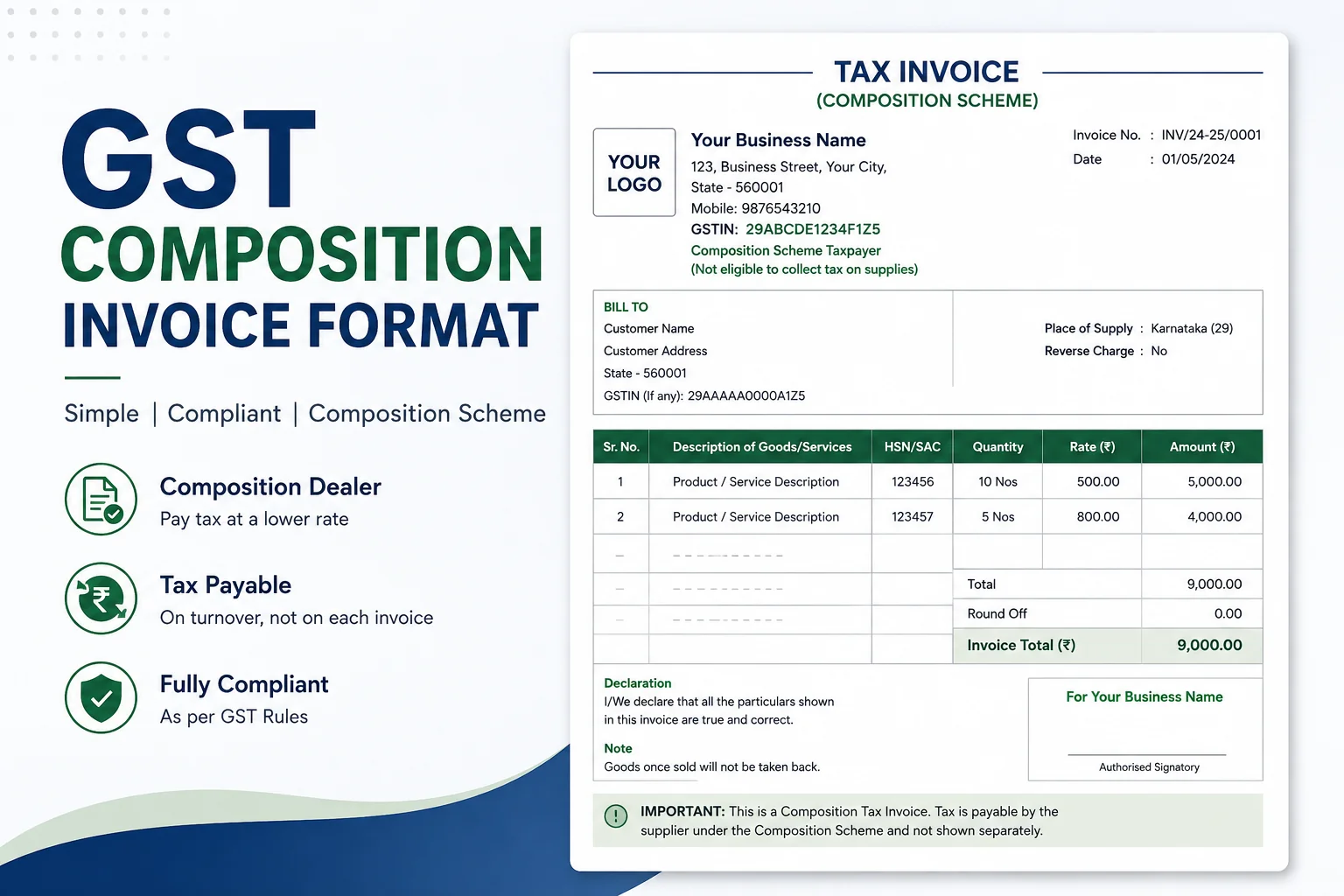
GST composition invoice format (copyable template)
Here’s a Bill of Supply laid out with all the Rule 5 fields in place. Copy the structure directly, or use the Excel version below if you want the totals to calculate automatically.
BILL OF SUPPLY

For composition taxable persons · Rule 5, CGST Rules 2017


"Composition taxable person, not eligible to collect tax on supplies"


SUPPLIER DETAILS

Name: [Your Business Name]

Address: [Registered Address]

GSTIN: [15-digit GSTIN]


BILL DETAILS

Bill No: [e.g. BOS/2026-27/001]

Date: [DD/MM/YYYY]

Place of Supply: [State Name]


RECIPIENT DETAILS

Name: [Customer Name]

Address: [Customer Address]

GSTIN (if registered): [GSTIN or blank]


ITEMS

Sr. 1 — Description: _______________ | HSN/SAC: _______ | Qty: _____ | Rate (₹): _______ | Value (₹): _______

Sr. 2 — Description: _______________ | HSN/SAC: _______ | Qty: _____ | Rate (₹): _______ | Value (₹): _______

Sr. 3 — Description: _______________ | HSN/SAC: _______ | Qty: _____ | Rate (₹): _______ | Value (₹): _______

Total value of supply: ₹ ______


Note: No CGST, SGST, or IGST column appears on a Bill of Supply. Tax is paid by the composition dealer directly to the government, not collected separately from the customer.


For [Your Business Name]

Authorised Signatory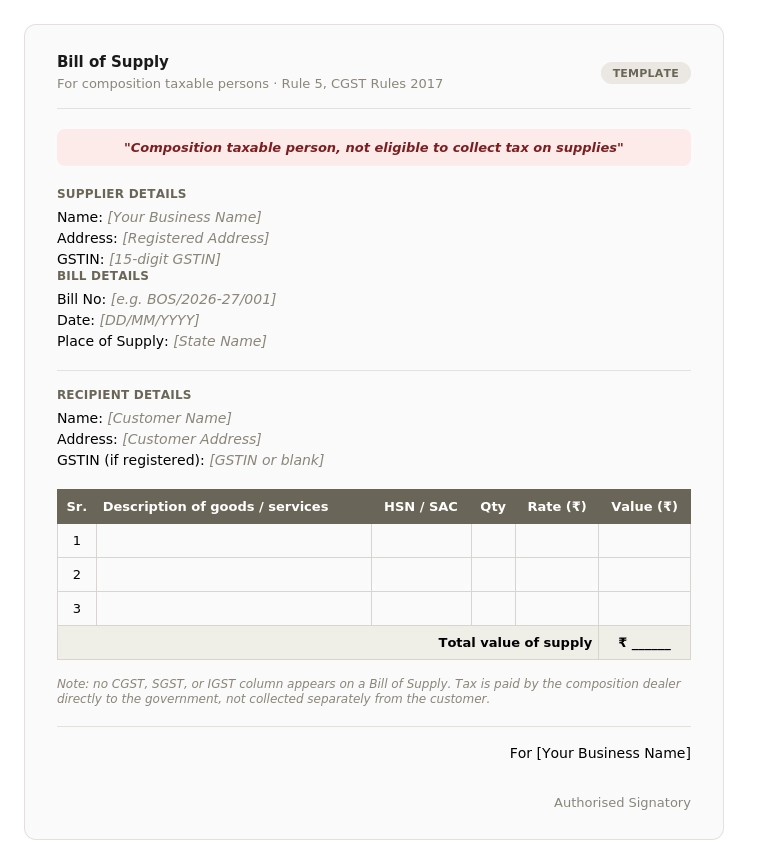
📊 Download: GST Composition Bill of Supply (Excel with auto-calculating) – enter quantity and rate, the value column and grand total calculate automatically.
What must NOT appear on a composition bill
This is where a lot of composition dealers accidentally slip back into regular-invoice habits, especially if they’ve used invoicing software that defaults to a tax-invoice layout.
- No CGST, SGST, or IGST columns. Tax is not shown or charged separately, at all, under any circumstance.
- No “Tax Invoice” heading. The document must say “Bill of Supply,” not “Tax Invoice” or “Invoice.”
- No tax rate percentages anywhere on the document, even for reference.
If a composition dealer’s software or template shows any of these, the resulting document isn’t a valid Bill of Supply under Rule 5, regardless of how professional it looks.
When a Bill of Supply isn’t required
Rule 5 carves out two narrow exemptions where a composition dealer doesn’t need to issue an individual Bill of Supply for every transaction.
- Value under ₹200. If the value of the goods or services supplied is less than ₹200, a Bill of Supply isn’t mandatory for that transaction.
- Consolidated daily bill. Instead of issuing separate bills for every small transaction through the day, a dealer can issue one consolidated Bill of Supply covering all such supplies made during that day.
Both exemptions have a limit worth remembering: if a customer specifically asks for a Bill of Supply, even for a transaction under ₹200, the dealer has to issue one. The exemption is about not being obligated to issue one by default, not a right to refuse when asked.
Bill of Supply for exports
If a composition dealer supplies goods for export, the Bill of Supply needs an additional declaration, and the exact wording depends on whether IGST was paid on that export.
- If IGST has been paid on the export: “Supply Meant For Export On Payment Of IGST.”
- If IGST has not been paid (export made under Bond or LUT instead): “Supply Meant For Export Under Bond Or Letter Of Undertaking Without Payment Of IGST.”
Export Bills of Supply also need to carry the buyer’s name and address, the delivery address, the destination country, and the number and date of the application for removal of goods for export.
GST composition invoice format vs. regular GST invoice format
| Field | Composition dealer (Bill of Supply) | Regular taxpayer (Tax Invoice) |
|---|---|---|
| Document title | Bill of Supply | Tax Invoice |
| Tax shown on document | No | Yes (CGST/SGST or IGST, itemised) |
| Buyer can claim ITC | No | Yes, subject to Section 16 conditions |
| Mandatory declaration | “Composition taxable person, not eligible to collect tax on supplies” | Not applicable |
| Governing rule | Rule 5, CGST Rules 2017 | Rule 46, CGST Rules 2017 |
Frequently asked questions
Can a composition dealer issue a tax invoice?
No. A composition dealer must issue a Bill of Supply, not a tax invoice, and cannot show or collect GST separately on it.
Is HSN or SAC code mandatory on a composition dealer’s bill?
Yes. Rule 5 requires the HSN code for goods, or the SAC code for services, on every Bill of Supply.
What happens if a composition dealer issues a tax invoice by mistake?
This is treated as non-compliance under Rule 5 and can also raise the question of whether GST was wrongly collected from the customer, which composition dealers aren’t authorised to do. It’s worth correcting immediately and reissuing a proper Bill of Supply.
Do I need to issue a Bill of Supply for every small sale?
Not necessarily. If the value is under ₹200, a Bill of Supply isn’t mandatory, and a single consolidated bill can cover all such small transactions for the day, unless a customer specifically asks for an individual one.
Can a Bill of Supply be issued digitally?
Yes. Rule 5 accepts either a physical signature or a digital signature of the supplier or their authorised representative.
Is a GSTIN required for the buyer on a Bill of Supply?
Only if the buyer happens to be GST-registered. For unregistered, walk-in customers, the buyer’s GSTIN field is simply left blank.
Can a composition dealer use regular invoicing software?
Only if it has a proper Bill of Supply mode that removes all tax columns and adds the mandatory declaration. Using software configured for regular tax invoices, without switching the format, produces a non-compliant document.
Where can I get a GST composition invoice format in Excel?
Use the download link in this article. It includes auto-calculating quantity, rate, and total value fields, with no tax columns, matching the Rule 5 Bill of Supply structure.
This article is for informational purposes only and is not investment or tax advice. Consult a qualified professional for decisions specific to your situation.