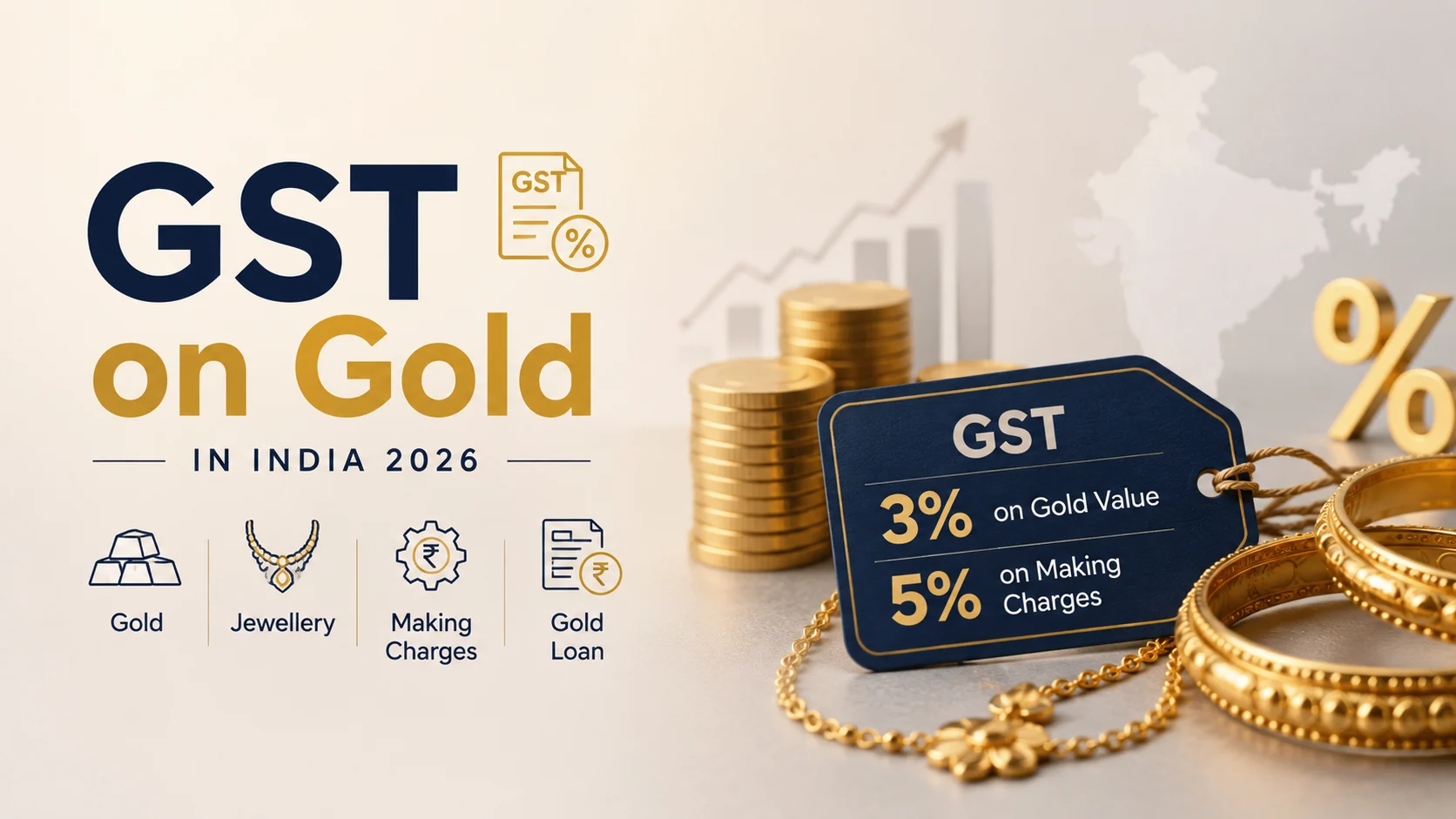
GST on gold in India is 3%, charged on the value of the gold itself, whether it’s a bar, coin, or jewellery. If you’re buying jewellery, there’s a separate 5% GST on making charges. Purity (18K, 22K, 24K) doesn’t change either rate. These numbers have stayed the same through the September 2025 GST 2.0 overhaul, so if you’ve seen “new GST on gold” headlines recently, they were almost certainly about customs duty, not GST. More on that distinction below, because it trips up a lot of buyers.
Page Contents
Current GST Rate on Gold (2026)
Here’s the full breakdown of what applies where:
| Item | HSN/SAC Code | GST Rate |
|---|---|---|
| Gold bars, coins, biscuits | 7108 | 3% |
| Gold jewellery (all purities) | 7113 | 3% |
| Gold products (non-jewellery) | 7114 | 3% |
| Making charges (billed separately) | 9988 / 998892 | 5% |
| Jewellery repair or polishing | — | 5% |
| Precious/semi-precious stones (specified) | 7103, 7104 | 0.25% |
On an intra-state sale, the 3% splits into 1.5% CGST + 1.5% SGST. For an inter-state sale, it’s 3% IGST outright. Either way, the total you pay works out the same.
One thing worth knowing from experience: most jewellers bill the gold value and making charges as a composite supply on a single line, which means the whole invoice attracts 3% rather than showing 3% and 5% separately. Whether you get a composite bill or a split bill can genuinely change your total by a small but noticeable amount, so it’s worth asking your jeweller to itemise the invoice before you pay.
GST on 24K, 22K and 18K Gold, Does Purity Change the Rate?
No. This is probably the most-searched confusion around gold GST, so let’s settle it clearly: the GST rate is 3% regardless of carat. What changes with purity is the base price of the gold, not the tax percentage.
- 24 carat gold GST rate: 3% on the gold’s market value. Applies to coins and bars, since 24K is rarely made into jewellery (it’s too soft to hold a setting).
- 22 carat gold GST rate: 3% on the gold’s market value. This is what most jewellery is made from.
- 18 carat gold GST rate: 3% on the gold’s market value, common in lightweight or diamond-studded jewellery.
Because 24K gold costs more per gram than 22K or 18K, the rupee amount of GST you pay on 24K will be higher for the same weight, even though the percentage is identical.
GST on Making Charges of Gold (5% Rate Explained)
Making charges cover the labour, design, and craftsmanship that goes into turning raw gold into a finished piece. These are taxed separately at 5%, treated as a service rather than a sale of goods.
Making charges themselves aren’t fixed by law. Jewellers typically quote them as either a flat rupee amount per gram or a percentage of the gold value (commonly somewhere between 3% and 25%, depending on design complexity). This is one area where it genuinely pays to negotiate: intricate handcrafted pieces carry higher making charges than machine-made, simple-design jewellery, and two jewellers selling the same design can quote very different making charges even when the gold rate they’re using is identical.
If you’re getting jewellery custom-made using your own gold, the making charges GST still applies separately at 5%, and if the goldsmith isn’t GST-registered, the jeweller pays this 5% on your behalf under the reverse charge mechanism.
Is GST Applicable on Gold Making Charges?
Yes, always, whenever making charges are billed. There’s no exemption for making charges the way there is for, say, SGBs on entry. The only variable is the rate: 5% on making charges versus 3% on the gold value itself, so the two components never get taxed at the same rate on a single invoice.
“0% Making Charges” But Still Charged GST, Why?
This trips up a lot of buyers who negotiate a jeweller down to “0% making charges” as a festive offer or loyalty discount, then still see GST on their final bill and assume they’ve been overcharged. They haven’t. Waiving making charges only removes the 5% GST component that applies to labour, since there’s no making-charge value left to tax. The 3% GST on the gold’s value itself still applies regardless, because that’s a separate tax on the gold, not on the craftsmanship. So a “0% making charges, GST extra” bill is correct: you’re seeing 3% GST on the gold value alone, not a hidden making charge in disguise. If your bill shows more than that on a genuine 0%-making-charge purchase, that’s worth querying with the jeweller directly.
How to Calculate GST on Gold: A Worked Example
Let’s say you’re buying a 10-gram 22K gold necklace, with 24K gold currently trading around ₹15,500 per gram (adjust for the day’s actual rate and the 22K conversion your jeweller uses).
| Step | Particulars | Amount |
|---|---|---|
| 1 | Value of 10g gold (assumed) | ₹1,40,000 |
| 2 | Making charges (assumed at 8%) | ₹11,200 |
| 3 | GST on gold value (3% of ₹1,40,000) | ₹4,200 |
| 4 | GST on making charges (5% of ₹11,200) | ₹560 |
| 5 | Total payable (1+2+3+4) | ₹1,55,960 |
So on a ₹1,40,000 piece of jewellery, GST alone adds roughly ₹4,760 to the bill. This is why the price tag at a jewellery counter is almost never the final amount you pay; always ask for a GST-inclusive quote before you commit.
(Note: these figures use an illustrative gold rate for calculation purposes. Check the live gold rate on the day of purchase for an accurate total.)
GST vs Customs Duty on Gold: Why “New GST on Gold” News Isn’t About GST
This is the part most articles on this topic get wrong or leave out entirely, and it’s probably why you’re seeing conflicting numbers if you’ve searched around.
GST on gold (3%) has not changed. The GST Council’s September 2025 rationalisation (often called GST 2.0) restructured most goods into 5%, 18%, and 40% slabs, but deliberately left gold outside that structure. It’s still 3%, same as it’s been since GST was introduced.
What did change is customs duty, which applies only to imported gold, not to gold you buy at a local jeweller with domestically available stock. Here’s the recent timeline:
- Union Budget 2024: customs duty cut sharply, from 15% to around 6% (5% Basic Customs Duty + 1% Agriculture Infrastructure and Development Cess).
- 13 May 2026: the government reversed this, raising the duty back up to 15% (10% Basic Customs Duty + 5% AIDC), citing rupee depreciation and current account deficit pressures.
Since most of India’s gold is imported, this duty hike flows into the price jewellers pay for raw gold, and from there into what you pay at the counter. But it shows up as a higher base gold rate, not as a change in GST. If you’ve read a calculation example anywhere online citing 6% or 12.5% customs duty, treat it as outdated: as of mid-2026, the effective import duty on gold is 15%.
In short: GST is the tax on the transaction (buying gold or jewellery from a seller). Customs duty is the tax on bringing gold into the country. Both add to your final cost, but only one of them is GST, and only one of them changed recently.
GST on Gold Loans
If you’re pledging gold to raise a loan, GST works differently here, and this is a genuine point of confusion for a lot of borrowers.
- Interest on the loan: no GST. Under GST law, interest is treated purely as the cost of borrowing money, not as a taxable service, so whatever interest rate your lender quotes is final, with no GST added on top.
- Processing fees, valuation charges, documentation fees, foreclosure charges: 18% GST. These are treated as service charges for evaluating, disbursing, and administering the loan, and they attract the standard 18% GST rate applied to financial services.
For example, if your gold loan processing fee is ₹1,000, you’ll pay ₹1,180 after GST. On a ₹1,00,000 loan with a 2% processing fee, that’s ₹2,000 plus ₹360 GST, meaning ₹97,640 actually lands in your account after the fee and tax are deducted upfront.
The practical takeaway: when comparing gold loan offers, don’t just compare the headline interest rate. A lender with a slightly higher rate but no processing or valuation fees can work out cheaper overall than one advertising a lower rate loaded with GST-attracting charges.
GST on Digital Gold, Gold ETFs, Mutual Funds and Sovereign Gold Bonds
| Investment type | GST on Purchase | GST on Related Charges |
|---|---|---|
| Digital gold | 3% | None extra |
| Physical gold (bars/coins) | 3% | None extra |
| Gold ETFs | 0% (exempt) | 18% on fund management/brokerage fees |
| Gold mutual funds | 0% (exempt) | 18% on fund management fees |
| Sovereign Gold Bonds (SGBs) | 0% (exempt) | 18% on brokerage, if bought via a broker |
Digital gold is taxed the same way as physical gold, at 3%, since you’re still buying an underlying gold asset, just stored in a vault rather than at home. Gold ETFs, mutual funds, and SGBs are different: you’re buying a financial instrument backed by gold, not gold directly, so GST doesn’t apply to the purchase itself. It only shows up on service-related charges like brokerage or fund management fees, typically at 18%.
If your priority is minimising indirect tax on a gold investment, SGBs and ETFs work out more tax-efficient than physical or digital gold, though they come with their own trade-offs around liquidity and whether you actually want to hold physical metal.
Is GST Applicable When Selling or Exchanging Old Gold?
Selling old gold to a jeweller: If you’re an individual selling personal jewellery, you don’t pay GST, since this isn’t treated as a business transaction on your end. The jeweller who buys it may have GST obligations on their side (often under the margin scheme, where they pay GST only on the difference between what they paid you and what they resell it for).
Exchanging old gold for new: GST doesn’t apply to the value of the old gold you hand over. You only pay GST on the value addition, meaning the extra new gold added plus the making charges on the new piece. So if you exchange a 10g necklace for a 12g one, GST applies to the 2 extra grams and the making charges on the new item, not to the full 12g.
Input Tax Credit (ITC) on Gold Purchases
This section applies mainly to jewellers and gold businesses rather than individual buyers.
Registered jewellers can claim ITC on GST paid for raw gold, job work, and other business inputs used in manufacturing, which offsets against the GST they collect from customers. This is standard GST mechanics: tax gets charged at each stage, but businesses can claim back what they already paid on inputs, so the end consumer isn’t double-taxed on the same value.
A few limits worth knowing: ITC isn’t available on gold purchased for personal use, and it’s specifically blocked on gold given away as gifts or promotional items (this came up in an actual Authority for Advance Ruling case involving a company that gave gold coins as a sales promotion and was denied ITC on them, since Section 17(5) of the CGST Act blocks credit on gifts). Individual retail buyers can’t claim ITC at all.
Frequently Asked Questions
What is the current GST rate on gold in India? 3% on the value of gold (jewellery, coins, and bars), plus a separate 5% GST on making charges for jewellery. This has remained unchanged through 2026.
Gold par kitna GST lagta hai? Gold par 3% GST lagta hai gold ki value par, aur agar jewellery bana rahe hain to making charges par alag se 5% GST lagta hai. Yeh rate 22K, 24K, ya kisi bhi purity ke liye same rehta hai.
Has GST on gold changed after GST 2.0 (September 2025)? No. The GST Council kept gold outside the new 5%/18%/40% slab restructuring. It’s still 3%. What changed separately was customs duty on imported gold, which rose to 15% in May 2026.
Does the GST rate differ for 22K vs 24K gold? No, the rate is the same 3% for any purity. Only the base gold value differs, which changes the rupee amount of tax, not the percentage.
Is GST applicable when I sell my old gold jewellery? No, not if you’re an individual selling personal jewellery. GST responsibilities, if any, fall on the registered dealer who buys it from you.
Do I pay GST on a gold loan? Not on the interest. You do pay 18% GST on processing fees, valuation charges, and similar service charges.
Is GST applicable on Sovereign Gold Bonds or Gold ETFs? No GST on the purchase itself. Brokerage or fund management charges, if any, attract 18% GST.
What is the GST HSN code for gold? 7108 for raw gold (bars, ingots), 7113 for gold jewellery, and 9988/998892 for job work and making charges.
Is GST charged on digital gold? Yes, at 3%, the same rate as physical gold.
Can I avoid paying GST on gold? No, GST is mandatory on gold and jewellery purchases in India. There’s no legal way around it for a standard retail purchase. SGBs are the closest legal option, since they’re exempt from GST on entry.
Disclaimer: This article is for general informational purposes only and does not constitute financial, tax, or legal advice. GST rates, customs duty, and related regulations are subject to change by government notification. Please verify current rates with the GST Council or a qualified chartered accountant, and consult a certified financial advisor before making investment decisions.
Read More: GST on Petrol and Diesel in India: Current Status, Rate and Updates