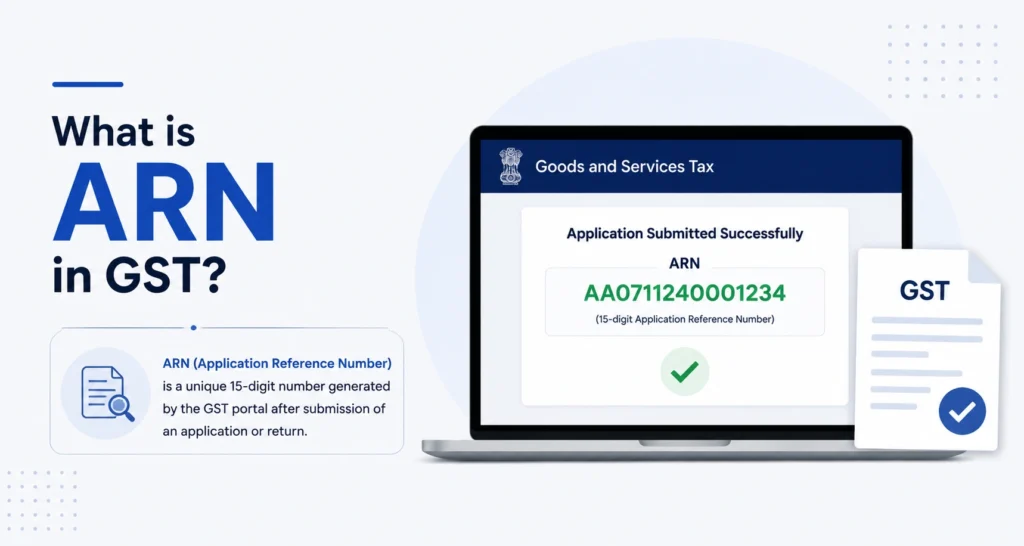
ARN in GST stands for Application Reference Number. It’s a 15-digit code the GST portal gives you the moment you submit a GST application, whether that’s a new registration, an amendment, or a clarification reply. Think of it as a receipt. It doesn’t mean you’re registered yet. It means your application has been received and is now in the queue for review.
Page Contents
What Does ARN Mean in GST
The ARN is your proof of submission. Before this number exists, your application is just a form sitting in a draft. Once you submit it, the portal locks in the ARN, and from that point on, it becomes the reference number for everything that happens next: tracking, officer queries, approval, or rejection.
You’ll usually get the ARN by SMS and email right after submission, and you can also find it on the GST portal under your application history.
ARN Number Format: What the 15 Characters Mean
The ARN isn’t a random string. It follows a fixed structure, which is why the portal is strict about entering it exactly as received.
| Position | What It Represents |
|---|---|
| First 2 characters | Letters indicating the application type |
| Next 2 characters | State code of the applicant |
| Next 4 characters | Month and year of application |
| Next 6 characters | Auto-generated unique serial number |
| Last character | Checksum digit (for error detection) |
You don’t need to decode your own ARN to use it, but knowing the structure explains why even one wrong character (a lowercase letter where the portal expects a capital, or a missing digit) makes the number invalid on the tracking page.
One thing worth clearing up: an ARN doesn’t expire on a fixed date the way an OTP does. It stays valid and usable for tracking until your application reaches a final outcome, approval or rejection. If you see a claim online about a fixed 90-day ARN expiry, that’s not accurate for the tracking function itself; what actually happens is that an unresolved application can end in rejection if you miss a clarification deadline, which is a different thing from the ARN itself expiring.
ARN vs TRN vs GSTIN: What’s the Difference
These three terms get mixed up a lot, and it’s a fair mix-up since they all show up during the same registration journey. Here’s how they’re different.
| Term | Full Form | When You Get It | What It’s For |
|---|---|---|---|
| TRN | Temporary Reference Number | When you start the application (Part A) | Lets you save your progress and come back later. Valid for 15 days. |
| ARN | Application Reference Number | When you submit the full application (Part B), after Aadhaar or biometric verification | Tracks your application through processing, right up to approval or rejection |
| GSTIN | Goods and Services Tax Identification Number | After your application is approved | Your actual, permanent GST registration number, used on every invoice and return |
So the order is: TRN gets you started, ARN gets you tracked, and GSTIN is the finish line.
What is ARN Number Used For
Once you have your ARN, it’s useful for more than just registration. You’ll need it if you want to:
- Check where your application currently stands
- Reply to a clarification request from a GST officer
- Refer to your application in any follow-up communication with the department
- Prove that you applied on a certain date, even if approval takes a while
How Many Days to Get a GST Number After ARN
This is the part where timelines online tend to disagree, and the reason is that the process genuinely isn’t the same for everyone.
- Standard applications: around 7 working days, once Aadhaar authentication is complete and nothing is flagged for manual review.
- Fast-track applications (Rule 14A): as few as 3 working days, for applicants whose projected monthly B2B output tax liability (CGST + SGST/UTGST + IGST combined) stays under ₹2.5 lakh. Only one registration per state or union territory is allowed under the same PAN.
- Applications needing physical verification: up to 30 working days, since a tax officer has to visit the business address before approving.
Working days exclude weekends and public holidays, so a Friday submission effectively starts its clock the following week. If your application gets flagged for clarification, the clock pauses until you respond, so a slow reply on your end adds directly to your wait.
There’s also a safeguard built into the process: if the officer doesn’t raise a query or pass an order within the applicable window, the registration is deemed approved automatically. In practice, this means administrative delay on the department’s side shouldn’t indefinitely hold up a clean application, though it’s not a substitute for tracking your ARN and responding to any notice promptly.
A Quick Word on ARN Status
Once your ARN is generated, it moves through a few stages, like Pending for Processing, Pending for Clarification, Approved, or Rejected. Each of these means something different, and knowing which one you’re looking at tells you whether to wait, act, or worry.
Since checking and tracking your ARN status deserves its own step-by-step walkthrough (with what each status actually means and what to do about it), we’ve covered that in detail here: How to Check GST ARN Status: A Step-by-Step Guide.
FAQs
What is the full form of ARN in GST? ARN stands for Application Reference Number. It’s generated after you submit a GST application.
Is ARN the same as GST number? No. ARN is a temporary tracking number for your application. Your GST number (GSTIN) is issued only after the application is approved.
Does my ARN expire? No, not on a fixed date. Your ARN stays valid for tracking until your application is finally approved or rejected. What can effectively end it is missing a deadline, like not responding to a clarification notice in time, which can lead to rejection.
What does ARN number mean if my application shows “Pending for Processing”? It means your application has reached the tax officer and is under review. No action is needed from you at this stage.
How many days does it take to get a GST number after ARN is generated? Typically around 7 working days for standard applications, 3 working days for eligible fast-track applicants under Rule 14A, and up to 30 working days if physical verification is required.
Can I use my ARN before I get my GSTIN? You can use it to track your application and respond to department queries, but you cannot use it to raise GST invoices. That requires your GSTIN.
This article is for general information only and isn’t a substitute for professional advice. GST rules and timelines can change, and your situation may differ. Check the latest guidance on the official GST portal or speak with a tax professional before making decisions based on this article.
Source: The official GST portal (gst.gov.in) or CBIC’s notification page for the current registration approval timeline and Rule 14A details.