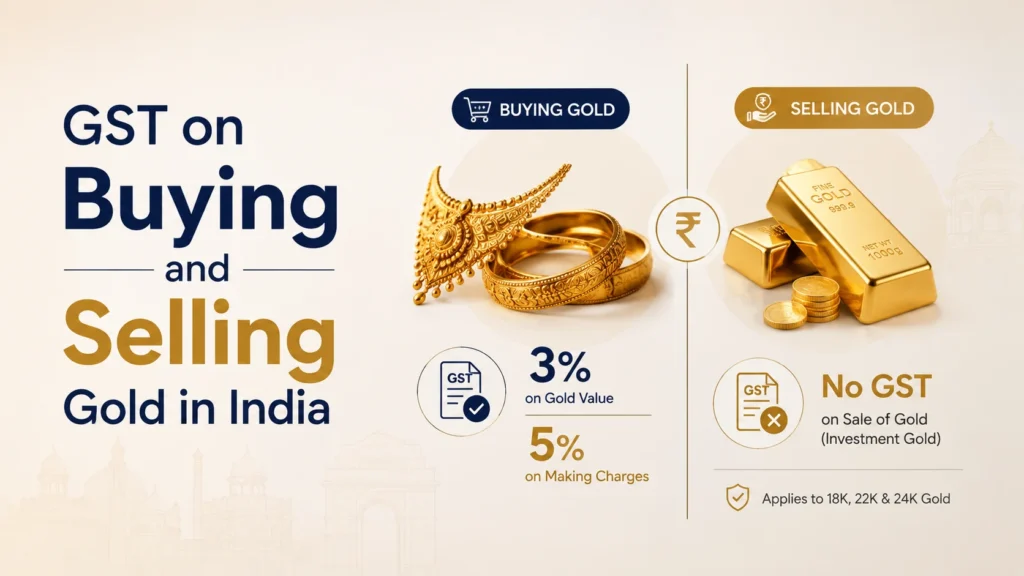
Buying gold always attracts GST: 3% on the gold’s value, plus 5% on making charges if it’s jewellery. Selling gold is different: if you’re an individual selling your own old jewellery or coins, you don’t pay any GST. The tax picture flips depending on which side of the counter you’re on, and that’s the part most buyers and sellers get confused about.
Page Contents
GST When You’re Buying Gold
Every gold purchase, whether it’s jewellery, a coin, a bar, or digital gold, attracts 3% GST on the value of the gold itself. Jewellery adds a separate 5% GST on making charges. This applies uniformly regardless of who you’re buying from (a jeweller, a bank, an online platform) or what purity you’re buying (18K, 22K, 24K).
This part of the transaction is non-negotiable and applies to everyone, business or individual, without exception. For the full rate breakdown across gold types, HSN codes, and worked calculations, see our complete guide to GST on gold in India.
GST When You’re Selling Gold
This is where it gets more nuanced, and where a genuine legal clarification from 2017 still answers most of the confusion today.
If You’re an Individual Selling Personal Gold
You don’t pay GST. This isn’t just a practical assumption, it’s a specific, named clarification from the Ministry of Finance. In July 2017, then–Finance Minister Arun Jaitley clarified in an official statement that the sale of old jewellery by an individual to a jeweller does not attract Section 9(4) of the CGST Act, 2017, meaning the jeweller isn’t liable to pay tax under reverse charge mechanism (RCM) on that purchase either.
The legal reasoning matters here: GST applies to a “supply” made in the course or furtherance of business. When you sell your own gold jewellery, you’re not running a gold-selling business, so the transaction falls outside GST’s scope entirely. This is the same principle that applies when you sell an old car or any other personal asset. Whether it’s a family heirloom or gold coins you bought as an investment years ago, the same rule holds.
If the Seller Is a Registered Dealer or Business
The exemption above only applies to individuals acting in a personal capacity. If an unregistered gold business or dealer sells old gold or ornaments to a registered supplier, GST under reverse charge does apply. The distinction is about who’s transacting, not what’s being sold: a private individual clearing out inherited jewellery is treated very differently from a business moving stock.
A Special Case: Giving Old Jewellery for Remaking
If you’re not selling your old gold outright but handing it to a jeweller to melt down and remake into something new, that’s treated differently again. This counts as job work, and attracts a 5% GST on the job-work/making charges, not the 3% rate that applies to an outright gold sale. The distinction the tax department draws is simple: are you selling the gold to the jeweller (a transfer of ownership), or are you paying them a service fee to reshape gold you still own? The latter is job work; the former is a sale.
Can You Legally Buy Gold Without Paying GST?
Short answer: not through a standard retail purchase. GST on gold is mandatory and there’s no legal workaround for buying jewellery, coins, or bars without it.
There is one legitimate exception worth knowing about: Sovereign Gold Bonds (SGBs) are exempt from GST at the time of purchase, since you’re buying a government security denominated in gold rather than the physical metal itself. If minimising GST outgo specifically is a priority (as opposed to holding physical gold), SGBs and Gold ETFs are the closest legal options, though they come with their own trade-offs around liquidity and not holding tangible gold.
Beyond that, be cautious of anyone offering to sell you gold “without GST” as a discount or workaround. A gold purchase without a GST-compliant invoice isn’t a legal exemption, it’s usually just an unregistered or non-compliant seller, which carries its own risks around purity certification, resale value, and any future dispute you might have no paper trail to support.
A Practical Checklist Before You Buy or Sell
Buying:
- Ask for a GST-inclusive quote upfront, not just the gold rate per gram
- Confirm the seller’s GSTIN is shown on the invoice
- Check whether making charges are itemised separately or bundled into a composite rate
Selling as an individual:
- No GST applies to you, but the jeweller may still record the transaction and could apply RCM logic on their end if you’re technically a registered supplier (rare for private individuals, but worth confirming if you run any kind of business)
- Get a fair-value receipt for the old gold regardless, useful for your own records even though no tax changes hands on your side
Remaking rather than selling:
- Clarify with the jeweller whether your gold is being bought (a sale) or reshaped (job work), since the tax treatment and paperwork differ
- Expect 5% GST on the job-work charges if it’s a remake, not a resale
Frequently Asked Questions
Is GST applicable when I sell my old gold jewellery? No, not if you’re an individual selling personal jewellery for non-business reasons. This was specifically clarified by the Finance Ministry in July 2017 and remains the rule today.
Who pays GST when I sell gold to a jeweller? Nobody, in the individual-to-jeweller scenario. The jeweller isn’t liable under reverse charge either, since your sale isn’t “in the course of business.”
Does GST apply when exchanging old gold for new jewellery? GST doesn’t apply to the value of the old gold you exchange. You only pay GST on the value addition, meaning the extra gold and making charges on the new piece.
Can I buy gold without paying GST at all? Not through a standard purchase. Sovereign Gold Bonds are the one GST-exempt route, since they’re a financial instrument rather than physical gold.
Is there GST on selling gold coins back to a jeweller? Same principle as jewellery: if you’re an individual selling personal gold coins, no GST applies to you or the jeweller under reverse charge.
What’s the difference between selling gold and giving it for remaking? Selling transfers ownership to the jeweller and is GST-free for an individual seller. Giving gold for remaking (melting and reshaping while you retain ownership) is job work, taxed at 5% on the making charges.
Does a registered business pay GST differently when selling old gold? Yes. The individual exemption doesn’t apply to businesses. If an unregistered gold business sells to a registered supplier, GST under reverse charge does apply.
Disclaimer: This article is for general informational purposes only and does not constitute financial, tax, or legal advice. GST rules and their application can vary based on specific circumstances. Please verify current requirements with the GST Council or a qualified chartered accountant before relying on this information, especially for any business or high-value transaction.